
8 min read ·
Find the Fault Before You Tow Again
Separate a missing 26C10 software fix from socket, fuse, module, and trailer faults, then verify brakes and lights before towing again safely.
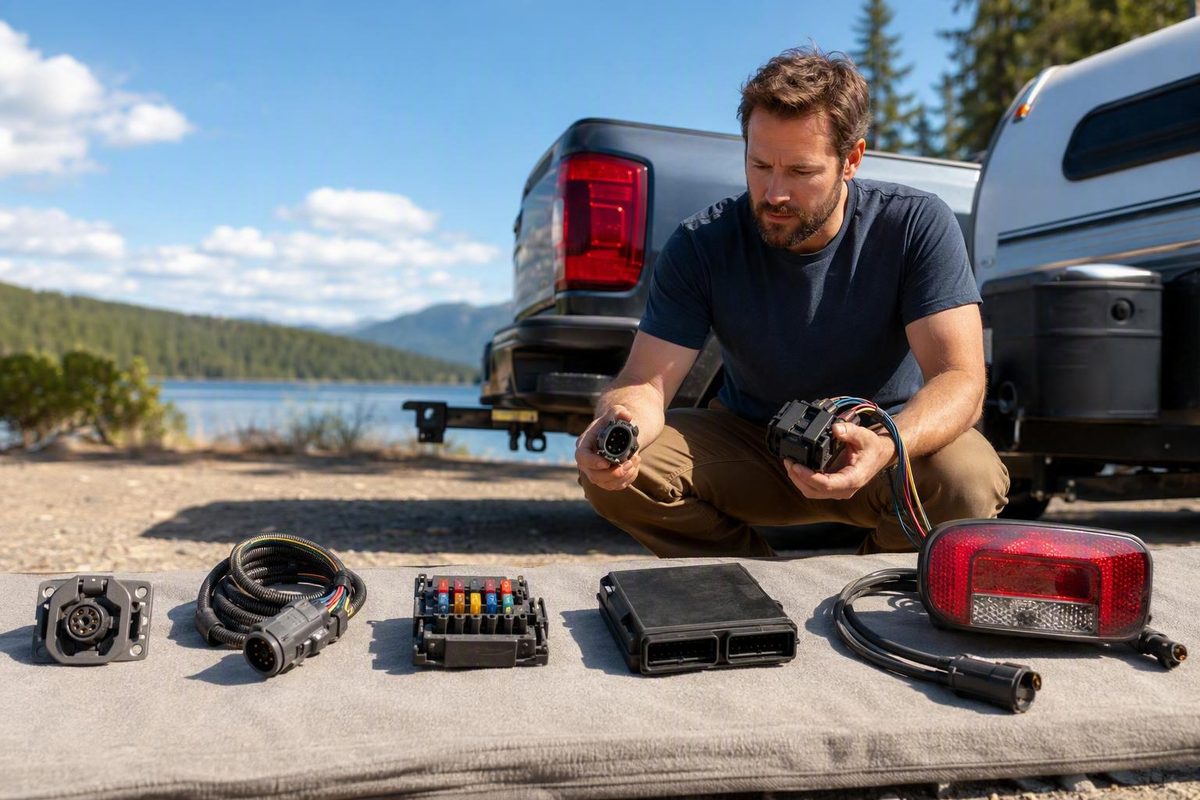
No. A Ford Trailer Brake Module Fault after a recall update does not by itself mean the 26C10 fix is missing or caused the problem. It could reflect incomplete programming, recurring module communication loss, a blown power-supply fuse, a corroded seven-pin connection, damaged truck wiring, or a trailer-side fault. Do not tow until the truck consistently recognizes the trailer and its brakes, stop lamps, and both turn signals have been verified.
Ford campaign 26C10, corresponding to NHTSA recall 26V104, covers about 4.38 million Ford and Lincoln tow vehicles. Ford’s quarterly reporting showed only about 706,000 repaired by mid-June 2026. A model appearing in the campaign announcement is not enough to establish coverage; the full VIN and programming record decide whether a particular vehicle received the remedy.
Choose the symptoms and service status; the tool identifies the leading diagnostic path and the checks required before towing.
Select what the truck does. The result ranks the next diagnostic path; it does not clear the vehicle for towing.
Towing verdict: Do not tow until recognition, brakes, stop lamps and both turn signals pass.
Ranked Diagnostic Path
- Confirm VIN status, calibration and programming logs.
- Scan ITRM/TRM communication, power and ground.
- Inspect the truck socket, harness and applicable fuses.
- Compare with a known-good trailer or simulator.
Record The Required Checks
| Vehicle Family | Campaign Scope | Remedy Route | What Decides |
|---|---|---|---|
| Ford F-150 | Certain vehicles within 2021–2027 span | OTA, dealer or mobile service when eligible | Full VIN |
| Ford Super Duty, including F-250 through F-600 | Certain vehicles within 2021–2027 span | OTA, dealer or mobile service when eligible | VIN, hardware and configuration |
| Ford Ranger | Certain vehicles within 2021–2027 span | OTA, dealer or mobile service when eligible | Full VIN |
| Ford Maverick | Certain vehicles within 2021–2027 span | OTA, dealer or mobile service when eligible | Full VIN |
| Ford Expedition | Certain vehicles within 2021–2027 span | OTA, dealer or mobile service when eligible | Full VIN |
| Lincoln Navigator | Certain vehicles within 2021–2027 span | OTA, dealer or mobile service when eligible | Full VIN |
| Ford Transit | 2026 designation named by Ford | Eligibility-dependent | Full VIN |
Source Ford campaign 26C10 and Integrated Trailer Module announcement; NHTSA campaign 26V104; Consumer Reports recall coverage. Model listing does not replace a VIN lookup.
The Warning Means Stop Towing Until Functions Pass
Postpone towing if the cluster displays “Trailer Brake Module Fault,” the turn indicator flashes rapidly, trailer recognition comes and goes, gain remains at zero, manual brake activation produces no verified response, or the trailer loses stop lamps or turn signals.
Ford says the condition addressed by 26C10 can leave the tow vehicle’s own brake lamps and turn signals working while the attached trailer loses those functions. On configurations with a high-series trailer module, electric trailer braking may also be lost. Ford’s official 26C10 campaign description identifies Trailer Module reprogramming as the remedy.
Working trailer lamps do not prove that the electric brakes work. Likewise, a functioning manual brake controller does not clear missing stop lamps or turn signals. Trailer recognition, lighting, controller communication, and brake output must each pass.
If the brakes fail, lock, drag, or apply unexpectedly while moving, stop the combination as safely as conditions allow and arrange assistance. A restart, plug reconnection, or temporarily cleared warning is not proof of repair.
Recall 26C10 Addresses Startup Communication Loss
The documented failure begins when the Integrated Trailer Module does not communicate properly as the vehicle starts or wakes. The cluster may show “Trailer Brake Module Fault,” the turn indicator may flash rapidly, and some vehicles may also display a Blind Spot Assist fault. If a trailer is attached, its stop lamps and turn signals may stop working; applicable high-series configurations may also lose electric braking.
Consumer Reports describes interrupted trailer braking and lighting and identifies free software reprogramming as the remedy in its 26V104 recall coverage.
Ford named certain vehicles in the F-150, Super Duty, Ranger, Maverick, Expedition and Lincoln Navigator families, plus 2026 Transit vehicles. The campaign broadly reaches vehicles from the 2021–2027 model-year span, but affected years, hardware, build dates and configurations vary. Check the VIN rather than relying on the badge or model year. Ford’s Integrated Trailer Module announcement says delivery may be over the air or through a dealer or mobile-service channel, depending on eligibility and remedy availability.
Ford presents reprogramming as the repair. Neither Ford nor NHTSA has established that installing the update creates a new Trailer Brake Module Fault. A warning first observed after service establishes timing, not cause.
Three Records Confirm Whether The Update Installed
Compare the VIN result, FordPass or OTA history, and the repair order. Use Ford’s campaign lookup and the NHTSA recall search, but recognize that a closed campaign entry does not reveal every programming detail.
The records should answer three separate questions:
- Does the VIN show 26C10 as open, incomplete, or closed?
- Does FordPass or the OTA history show success, failure, retry, or no event?
- Does the repair order explicitly record successful Trailer Module programming under 26C10?
These records can disagree. An app may report a failed attempt while another system shows the campaign closed. That contradiction does not let an owner determine which calibration is installed.
Ask the dealer to identify the installed Trailer Module software or calibration, installation date and delivery method. The record should also state whether programming completed, whether errors occurred and whether the module communicated and passed operational testing afterward.
There is no universal calibration number in the available evidence that an owner can apply across every model and hardware configuration. Confirmation must be specific to the VIN.
Symptom Timing Separates The Likely Fault Domains
A warning at startup or wake-up closely resembles the recalled communication condition, including when no trailer is attached. That makes software status, programming logs and network communication the first checks. It does not prove the remedy failed.
Record whether the warning appears at the first start of the day, after a long parked period, immediately after pressing Start, only after connecting a trailer, or after shifting into gear. An intermittent startup pattern matters because 26C10 specifically addresses startup or wake-up communication.
A fault confined to one trailer shifts attention toward that trailer’s plug, cable, accessible junctions, grounds, lamps, brake wiring and breakaway system. Inspect the plug, cable, accessible junctions for loose terminations, damaged insulation, water intrusion and previous repairs.
A fault with multiple known-good trailers—or with no trailer connected—more strongly supports a truck-side problem. Relevant areas include software, vehicle-network communication, Trailer Module power and ground, vehicle configuration, the truck’s seven-pin socket and harness, and the module itself.
A fault that follows rain, washing, vibration or plug movement makes a connection problem more plausible. Look for moisture; green, white or dark corrosion; bent, spread or recessed terminals; dirt; weak latch engagement; harness strain; and compromised grounds. The pattern is evidence, not a final diagnosis.
The Seven-Pin, Fuse And Trailer Need Separate Tests
The dashboard brake-controller interface, Integrated Trailer Module, truck socket and trailer wiring are separate parts of the system. “Trailer brake module” is often used for all four, which can lead to replacing the wrong component.
Begin with a visual inspection of both connectors. With the vehicle secured and its electrical system in the appropriate state, inspect both seven-pin connections for water, corrosion, debris, heat damage, cracked housings, loose terminals and cable damage. Do not force a terminal back into shape without the correct tools and service information.
Check the applicable Trailer Module, trailer-tow and brake-controller power supplies using the owner information and current service procedure for the exact VIN. Fuse numbers and circuit layouts vary, so the available evidence does not support one universal fuse location or rating. A replacement fuse that blows again indicates an unresolved circuit fault; do not keep installing fuses or increase the rating.
Next, inspect trailer wiring and grounds. Trace accessible wiring for chafing, pinching, loose junctions, damaged insulation, weak frame grounds and compromised brake wiring. A trailer that fails on another suitable tow vehicle or tester becomes the leading fault domain.
A known-good trailer or suitable simulator can divide the problem further. If the original trailer fails and known-good equipment passes repeatedly, trailer-side trouble becomes more plausible. If multiple known-good trailers fail, concentrate on the truck. If a simulator passes but a real trailer fails, investigate connection quality, current demand, configuration and trailer wiring. An intermittent pass does not clear the system.
Cleaning or drying a connector may change the symptom without proving the cause. Dielectric grease does not repair a loose, corroded or heat-damaged terminal, and it does not establish that module communication or braking has been restored.
Module Codes Must Be Saved Before They Are Cleared
Ask a qualified technician for a full vehicle scan and a copy of the results before codes are erased. The warning text alone does not identify the failed component.
Third-party commercial guidance cites U0137 and U0252 as possible communication-loss codes and B1D08:11 and B1D09:11 in some connector-corrosion contexts. These are model-dependent leads, not universal diagnoses. Their relevance depends on the vehicle, configuration, symptoms and current Ford service information.
The dealer’s diagnosis should verify 26C10 completion, installed calibration, programming errors, ITRM or TRM network communication, module power and ground, vehicle configuration, socket and harness condition, and applicable pinpoint-test results. It should also test trailer detection, gain adjustment, commanded manual-brake operation, stop lamps and both turn signals with suitable equipment.
Where the current Ford procedure supports it, ask the dealer to verify or reinstall the prescribed software before condemning hardware. Repeatedly flashing a module without diagnosis is not a substitute for checking its power, ground, network and connected circuits.
Replacement modules may require VIN-specific programming or configuration rather than simple physical installation. Confirm the procedure for the exact VIN before buying a module.
Every Towing Function Must Pass After Repair
Test the actual truck, socket, plug, adapter and trailer that will be used. An app status, cleared code or unloaded simulator result cannot replace a complete check of the real combination.
At the instrument panel, confirm there is no Trailer Brake Module Fault, rapid turn indication, related Blind Spot Assist warning or recurring trailer-disconnected message. Repeat the observation over more than one normal startup cycle because the recalled condition is associated with startup or wake-up.
Confirm that the truck consistently recognizes the trailer and that the cluster, controller display and trailer menus agree. An active trailer profile paired with “no trailer” at the brake controller requires diagnosis even if the lamps illuminate.
Verify that gain can be adjusted and does not remain at zero. Manual controller activation must produce the expected brake response during a controlled test suitable for that trailer. Do not improvise a high-speed test.
Have another person observe the trailer stop lamps, left turn signal, right turn signal and required running lamps. Do not infer brake operation from working lights or infer lighting operation from brake response.
If operation returns only after restarting, unplugging or moving the cable, classify the fault as intermittent and unresolved. The final repair order should record the software installed, stored and current codes, programming and network results, connector findings, equipment used for testing, output results and confirmed root cause.
An Unresolved Post-Remedy Fault Should Be Escalated
Preserve the VIN, repair order, FordPass screenshots, warning photos, mileage, startup sequence, diagnostic codes, trailer identity, weather or washing exposure, and details of any aftermarket controller, adapter or retrofit. Note whether moving the plug changes the symptom and whether one or several trailers are affected.
Ask the service manager to open or update a Ford case if the first visit does not resolve the problem. Consumer Reports listed Ford’s contact number as 866-436-7332; verify that it remains current before relying on it.
If a suspected safety defect remains after the documented recall remedy, file a report through NHTSA. Include campaign 26C10 or 26V104, the service date, recurring symptoms, effects on trailer brakes or signals, and the dealer’s findings.
A closed recall entry is not permission to tow through an active fault. Resume towing only after trailer recognition, electric braking, stop lamps and both turn signals work consistently through normal startup and connection cycles.