
18 min read ·
Know What Your Trailer Needs Before You Tow It
Fit applicable lights before public-road towing. For trailers under 6 feet, summaries say specified front side markers and reflectors may be omitted.
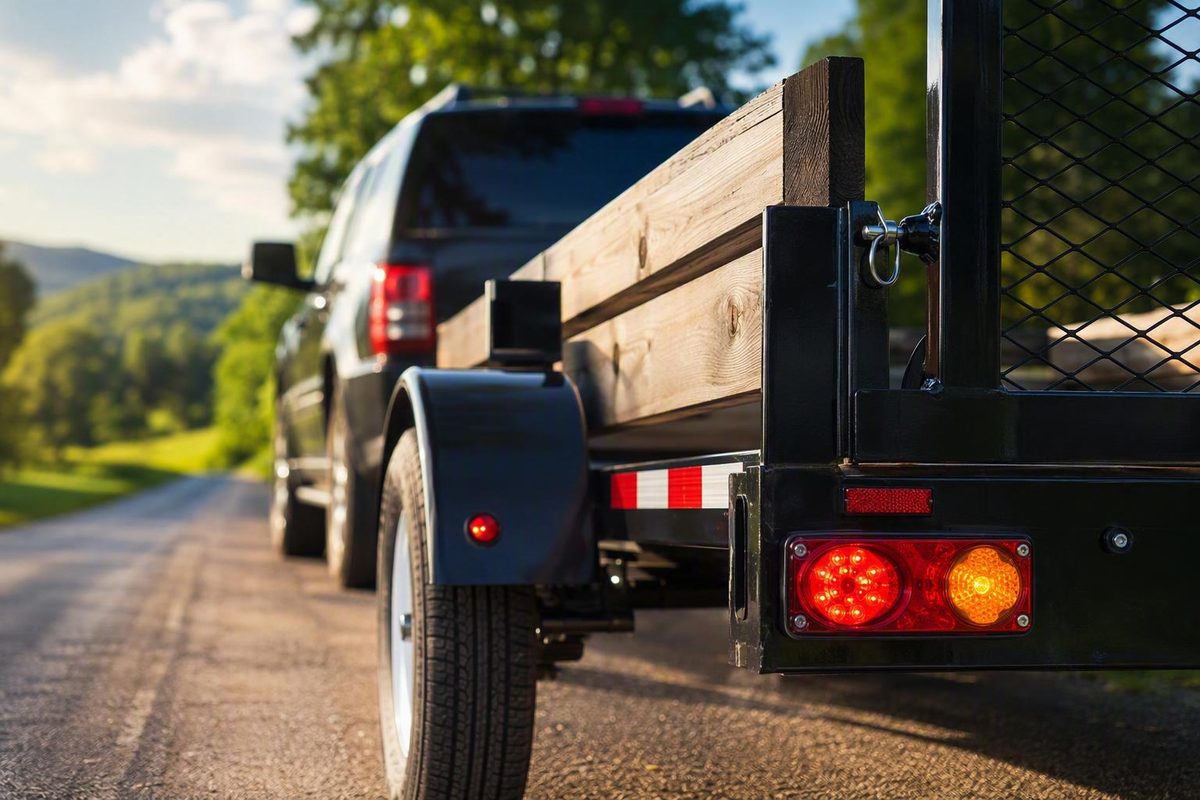
The short answer: install the required equipment before public-road towing
A trailer intended for operation on U.S. public roads generally should have all applicable lamps and reflective devices installed, connected, visible, and working before it is towed. That is practical compliance guidance, not a universal statutory deadline for every trailer in every jurisdiction.
There is no single equipment list that applies identically to every trailer. The relevant configuration can depend on:
- The state where the trailer is registered
- Other states where it will be operated
- Overall width and length
- Gross Vehicle Weight Rating (GVWR)
- Trailer type and configuration
- Model or construction year
- Whether the trailer, its equipment, or its load obstructs required lamps
Commercial U.S. summaries commonly identify tail lamps, stop lamps, turn-signal lamps, reflectors, side-marker devices, and license-plate illumination as road-going trailer equipment. They also describe additional devices associated with dimensions and weight ratings and direct readers to 49 CFR 571.108, commonly called FMVSS No. 108. State requirements may supplement that federal framework. Etrailer’s summary explains these variables and identifies the federal section readers should verify.
Two questions must be kept separate:
- When must lights be physically installed? This asks what equipment the trailer must carry and how it must be mounted.
- When must installed lights be illuminated? This asks when the lamps must be switched on, such as during darkness or reduced visibility.
The supplied evidence supports a cautious installation guide. It does not establish one nationwide rule for switching trailer lamps on after dark, during rain or fog, before registration, or before inspection. Those questions often depend on state operating, registration, and inspection law.
Scope note: This is educational, U.S.-focused guidance—not a definitive legal determination for every trailer or state. The commercial summaries discussed below are not substitutes for the current federal text or official state law. Confirm the rules for every relevant jurisdiction before building, modifying, registering, inspecting, or towing a trailer.
Start with six facts about the trailer
Do not select a light kit from a photograph or from a description such as “small utility trailer.” Start with a worksheet.
| Fact to record | Your trailer |
|---|---|
| Registration state | |
| Other operating states | |
| Trailer type and use | |
| Model or construction year | |
| Overall width | |
| Overall length | |
| GVWR shown on the certification or rating information | |
| Trailer, deck, equipment, or cargo blocks any lamp? | Yes / No / Uncertain |
The six core facts are jurisdiction, type, age, width, length, and GVWR. The obstruction question deserves its own entry because a trailer with the expected equipment can still have ineffective lighting if a ramp, spare tire, tilted deck, machine, or load blocks a lamp.
Measure width rather than guessing from trailer type
The under-80 versus 80-inches-and-wider distinction concerns overall trailer width, not whether the trailer is marketed as a utility, boat, cargo, or light-duty trailer. Manufacturer guidance recommends measuring at the widest point, generally including projecting fenders or side steps, and places a trailer measuring exactly 80 inches in the 80-inches-or-wider category. Venture Trailers describes this practical measurement method and category threshold.
That guidance is useful for selecting equipment, but it is not the controlling legal definition in every situation. Confirm how the applicable rule treats fixed projections, removable equipment, and cargo. Do not assume that frame width alone is the relevant overall width.
Inclusive wording also matters. A provision written for trailers at least 80 inches wide includes an exactly 80-inch measurement. A provision written for trailers over a stated measurement does not necessarily include equality. Read the actual wording instead of treating “at least,” “more than,” and “over” as interchangeable.
Keep GVWR separate from actual weight
GVWR is a rating.
Do not substitute one measure for another unless the applicable provision expressly uses or permits it. A federal summary written in terms of GVWR should not automatically be applied using empty weight. A state provision using gross weight should not silently be converted into a GVWR rule.
Use this decision sequence
- Identify the jurisdiction. Record the registration state and every state where the trailer will be operated.
- Establish the use. Determine whether the trailer will enter a public road or remain entirely on private property.
- Measure and document it. Record overall width and length using the controlling measurement method where available.
- Record the relevant weight measures. Find the stated GVWR, then separately record actual or registered weight if a state rule uses it.
- Identify class and age. Note whether it is a utility, boat, cargo, pole, agricultural, homemade, imported, or other specialized trailer.
- Check for obstruction. Evaluate both the empty trailer and its normal loaded configuration, including ramps and movable decks.
- Build an equipment matrix. Start with the potentially applicable baseline devices, then evaluate width, length, weight rating, configuration, age, and state-law categories separately.
- Verify the result officially. Do not make design or omission decisions solely from a retailer’s chart.
Baseline lamps and reflectors commonly specified for U.S. trailers
The following table reproduces the basic configuration reported by a commercial U.S./Canadian lighting poster. It is a screening checklist, not a declaration that every existing trailer in every state must carry an identical set of devices.
| Device | Quantity and color reported by the summary | Type | Function |
|---|---|---|---|
| Tail lamps | At least two, red | Lamp | Show the trailer’s presence and width from the rear |
| Stop lamps | At least two, red | Lamp | Indicate braking |
| Rear turn-signal lamps | At least two, red or yellow | Lamp | Communicate turning direction |
| Rear reflex reflectors | At least two, red | Non-illuminated reflector | Return light toward approaching traffic |
| License-plate lamp | At least one, white | Lamp | Illuminate the registration plate |
| Rear side-marker lamps | Red | Lamp | Show the rear portion of the trailer from the side |
| Rear side reflex reflectors | Red | Non-illuminated reflector | Define the rear portion from the side |
| Front side-marker lamps | Yellow | Lamp | Show the front portion from the side |
| Front side reflex reflectors | Yellow | Non-illuminated reflector | Define the front portion from the side |
The poster reports these quantities and colors as basic trailer equipment and states that lamps, reflex reflectors, and conspicuity devices must be permanently attached in specified locations and meet applicable FMVSS or CMVSS requirements. Its U.S. information should still be checked against the current federal text, including scope, effective dates, trailer classifications, and exceptions. See the commercial trailer-lighting and reflective-device matrix.
Some approved combination housings can perform more than one function. A rear unit, for example, may provide tail, stop, and turn functions.
Likewise, a package labeled “trailer light kit” does not prove compliance. A kit may omit:
- Front or rear clearance lamps
- A three-lamp rear identification cluster
- Intermediate side markers
- Required reflectors
- License-plate illumination
- Conspicuity material
Even a complete collection of components can be installed in the wrong locations or where the trailer structure blocks visibility.
Small and narrow trailers may have limited exceptions—not a no-lights exemption
Commercial federal summaries report a limited provision for trailers under 6 feet long: specified front side-marker lamps and front side reflectors may be omitted. Those same summaries continue to list applicable rear tail, stop, turn-signal, reflector, side-visibility, and license-plate-light equipment rather than describing a general no-lights exemption. Custer Products reports both the short-trailer provision and the remaining equipment categories.
The summaries also report a reduced arrangement for a trailer under 30 inches wide: one centrally mounted brake lamp, one tail lamp, and one rear reflector. Because this design-level exception is supported here only by commercial summaries, do not omit equipment on that basis until the current federal text and applicable state rules have been checked.
Actual dimensions, rating, configuration, construction date, use, and jurisdiction matter.
Worked example: a five-foot utility trailer
Assume a utility trailer is:
- 5 feet 6 inches long
- 60 inches wide
- Intended for public-road use
- Not otherwise within a specialized category
The reported under-6-foot provision may allow specified front side-marker lamps and front side reflectors to be omitted. It does not support towing the trailer with no lighting. The owner would still need to evaluate rear tail, stop, and turn functions; rear reflectors and side-visibility devices; license-plate illumination; and state-specific requirements.
The correct approach is narrow: omit only equipment that a verified provision expressly allows the particular trailer to omit. Never convert a front-marker provision into the broader claim that small trailers need no lights.
The three major thresholds: 80 inches, 30 feet, and 10,000 pounds GVWR
Width, length, and GVWR are separate tests associated with different equipment categories. They are not interchangeable.
| Trailer characteristic | Category to investigate |
|---|---|
| Baseline road-going trailer | Tail, stop, and turn lamps; plate illumination; rear reflectors; applicable front and rear side-marker lamps and reflectors |
| At least 80 inches in overall width | Front and rear clearance lamps plus a three-lamp rear identification cluster |
| At least 30 feet in overall length | Intermediate yellow side-marker lamp and reflector on each side near the center |
| Wide and heavy trailer within the relevant regulatory scope | Red-and-white conspicuity treatment; the supplied summaries disagree about whether the GVWR wording includes exactly 10,000 pounds |
A commercial poster reports that trailers at least 80 inches wide require at least two yellow front clearance lamps, at least two red rear clearance lamps, and exactly three red rear identification lamps. It also reports that trailers at least 30 feet long require at least one yellow intermediate side-marker lamp and reflector on each side near the center. The same poster presents these width- and length-based categories.
At least 80 inches wide
Clearance lamps communicate the presence and outer extent of a wide trailer.
Do not use a generic kit diagram to determine final mounting positions. Exact location, spacing, permitted combinations, orientation, and performance requirements must come from the current rule applicable to the trailer.
At least 30 feet long
The reported intermediate side-marker category addresses visibility along a long trailer body. It does not replace the baseline side devices or, when separately applicable, wide-trailer clearance and identification lamps.
A trailer can cross the length threshold without crossing the width threshold. Conversely, it can cross the width threshold while remaining shorter than 30 feet.
Width plus GVWR for conspicuity treatment
One supplied commercial poster describes red-and-white conspicuity treatment for trailers within its relevant scope that are both:
- At least 80 inches wide, and
- At least 10,000 pounds GVWR
It identifies the sides, rear lower body, bumper-bar area, and rear upper body as treatment areas at a high level.
Another supplied summary instead describes the weight condition as over 10,000 pounds GVWR. Because “at least 10,000” and “over 10,000” produce different results for a trailer rated exactly 10,000 pounds, this evidence cannot reliably resolve that boundary case. Etrailer’s summary illustrates the conflicting “over 10,000 pounds” wording.
Before installing or omitting conspicuity material, check the current federal text for:
- The precise threshold wording
- Applicable trailer types
- Manufacturing or applicability dates
- Exclusions and specialized configurations
- Required treatment areas and patterns
- Any state requirements affecting an in-service trailer
Do not infer that width alone, length alone, or actual loaded weight automatically triggers every conspicuity category.
Four worked examples
1. A 79-inch-wide, 12-foot trailer
This hypothetical trailer is below the reported 80-inch width and 30-foot length categories. Begin with the potentially applicable baseline equipment, but verify the measurement and jurisdiction before deciding that wide- or long-trailer devices can be omitted.
2. A trailer measuring exactly 80 inches wide
Where the controlling provision says “at least 80 inches,” exactly 80 inches is included. The wide-trailer configuration should therefore be investigated, including clearance lamps and the three-lamp rear identification cluster.
3. A 32-foot trailer under 80 inches wide
Under the reported commercial matrix, length calls for evaluation of intermediate side-marker lamps and reflectors. Being longer than 30 feet does not itself make the trailer at least 80 inches wide.
4. A wide trailer rated at exactly 10,000 pounds GVWR
The supplied evidence does not settle this example. One summary uses “at least 10,000 pounds,” while another uses “over 10,000 pounds.” Do not classify an exactly 10,000-pound trailer from these summaries alone; check the current official provision and its applicability rules.
A compliant lamp must be mounted where it can do its job
Having the expected number of energized lamps is not enough. A required device must be suitable for its function and installed so that it satisfies the applicable location, orientation, visibility, color, symmetry, attachment, and performance rules.
A rear lamp can illuminate and still be improperly installed if it is:
- Too far underneath a deck
- Hidden by a ramp, tailgate, spare tire, machine, or load
- Facing in the wrong direction
- Loose or able to rotate
- Installed on only one side where symmetry is required
- The wrong color for its position or function
- Wired so one required function improperly disables another
Inspect the loaded configuration, not merely the empty frame. A tilting deck can expose lamps in one position and hide them in another. Cargo can extend around otherwise suitable lamps.
A limited example appears in a 1986 NHTSA interpretation involving a wide tilting flatbed. NHTSA said the proposed arrangement apparently lacked clearance lamps and placed other rear devices too far under the platform to meet the cited rear-location or visibility requirements. It also explained that auxiliary lamps may be necessary when vehicle equipment prevents required devices from meeting applicable visibility requirements. Read NHTSA’s case-specific interpretation.
That interpretation concerned one proposed design under the standards then in effect. Its old standard references and visibility details should not be treated as a complete statement of current law. Its narrower practical lesson remains useful: trailer structure and equipment cannot be allowed to defeat the required visibility of rear devices.
What about magnetic or portable lights?
The supplied evidence does not establish that magnetic lamps or portable light bars are universally acceptable substitutes for installed equipment. Their acceptability may depend on attachment requirements, position, orientation, wiring, visibility, performance, and state law.
Before relying on temporary equipment, verify:
- Whether permanent attachment is required for that device and trailer category
- Whether the proposed mounting position is permitted
- Whether the lamp remains correctly oriented
- Whether the cable and connections are protected
- Whether every required function is provided
- Whether the registration and operating states accept the arrangement
Use a validated mounting diagram only after identifying the correct regulatory category and consulting the current rule and relevant state authority.
Federal equipment standards and state road-use laws answer different questions
FMVSS No. 108 and 49 CFR 571.108 are the federal framework identified by the supplied sources for lamps, reflective devices, and associated equipment. A commercial compliance guide also warns that federal requirements may be supplemented by state rules. The Trailer Showroom guide summarizes this federal-and-state distinction.
State law can separately address:
- Registration and titling
- Pre-registration or periodic inspection
- Equipment required during road use
- Times and conditions when lamps must be illuminated
- Older, homemade, agricultural, or specialized trailers
- Loads that block towing-vehicle or trailer lamps
- Repair, replacement, and retrofit obligations
The supplied evidence does not establish that every state requires completed lighting before registration, titling, sale, or inspection. Check the official process for the trailer’s class and circumstances.
South Carolina as an example of state variation
A third-party reproduction of the 2025 South Carolina Code illustrates why state review matters. It reports additional equipment for trailers or semitrailers over 3,000 pounds gross weight, including front and rear clearance lamps, side-marker lamps and reflectors, rear reflectors, and a stop lamp. For trailers, semitrailers, or pole trailers weighing 3,000 pounds gross or less, it reports two rear reflectors; it also calls for a stop lamp when the dimensions or load of a light trailer or semitrailer obscure the towing vehicle’s stop lamp. See the reproduced South Carolina provision and its weight categories.
This is a state-specific example, not a national rule. The reproduced section says its equipment applies under conditions defined in a cross-referenced provision that is not reproduced on the cited page. Justia is also not South Carolina’s official legislative publisher and warns that its text may not be the latest or most accurate version.
The excerpt therefore cannot establish by itself exactly when the lamps must be illuminated. Verify the provision, its cross-reference, and its current status through an official South Carolina source before relying on it.
A verification workflow
Before treating an installation as complete:
- Check the current federal text. Locate the current version of 49 CFR 571.108 through the official Electronic Code of Federal Regulations. Identify the relevant trailer category, applicability date, definitions, and tables.
- Separate manufacturing rules from owner-use duties. Determine whether the provision governs manufacture or sale, an in-service trailer, or both.
- Check the registration state. Use the official legislature, administrative code, department of motor vehicles, transportation agency, or state police website.
- Check operating states. Review relevant equipment and illumination rules in every state where the trailer will travel.
- Read inspection and registration instructions. Confirm whether weight, age, homemade status, or specialized use changes the process.
- Resolve terminology. Determine whether each provision uses GVWR, gross weight, registered weight, unladen weight, or another measure.
- Ask directly about exceptions. Confirm specialized-trailer classifications and temporary-light arrangements rather than inferring them.
- Record the result. Save the issuing authority, section number, URL, and date consulted because statutes, regulations, and agency guidance can change.
Pre-tow lighting and wiring check
A legal equipment list is useful only if the installed system works with the actual tow vehicle. Treat the following as a practical maintenance routine, not as certification of legal compliance.
1. Test every powered function
With the trailer coupled to the tow vehicle, test:
- Tail or running lamps
- Both brake lamps
- Left turn signal
- Right turn signal
- Hazard operation, where applicable
- License-plate illumination
- Clearance lamps, if applicable
- Rear identification lamps, if applicable
- Intermediate side-marker lamps, if applicable
2. Inspect reflective devices
Walk around the trailer and inspect the devices potentially applicable to its configuration:
- Rear reflex reflectors
- Front and rear side reflectors
- Intermediate side reflectors
- Red-and-white conspicuity material
Confirm that they are present, firmly attached, correctly colored, clean, and visible.
3. Check lenses, mounting, and visibility
Confirm that each lens is:
- Present and securely attached
- The correct color for its assigned position and function
- Clean and not badly cracked
- Facing in its intended direction
- Visible with the trailer in its normal loaded configuration
Look for obstruction by ramps, tie-downs, spare tires, toolboxes, outboard motors, machinery, tilted decks, or cargo overhang. A lamp should remain firmly mounted and properly oriented rather than merely lighting up.
4. Inspect the plug and cable
Examine the connector for:
- Bent or loose contacts
- Pushed-back terminals
- Dirt, moisture, or corrosion
- Inadequate strain relief
- A cable that can drag or pull tight during turns
Follow the harness along the frame and look for abrasion, crushed insulation, unsupported wire, sharp edges, loose junctions, water intrusion, and contact with tires, suspension, hinges, or moving ramps.
5. Check the grounds
Inspect the trailer ground and any local lamp grounds for looseness, corrosion, paint, rust, or damaged conductors.
Then operate multiple functions together—for example, running lamps with a turn signal, followed by the brakes.
6. Test with the actual tow vehicle
Testing with the actual vehicle can reveal:
- An incorrect connector pinout
- A tow-vehicle fuse or module problem
- A poor shared ground
- A damaged socket
- Incompatible wiring arrangements
- A fault that appears only when several circuits operate together
Repeat the full functional test after every repair.
7. Treat the checklist as maintenance, not certification
Passing this checklist does not prove that:
- The lamp is approved for its assigned function
- Its mounting geometry satisfies the controlling rule
- Every required device has been identified
- A state-specific requirement does not apply
- The trailer has passed any required official inspection
The practical answer remains straightforward: install and test the applicable lamps and reflective devices before towing on public roads, then verify the legal equipment list from official federal and state sources.
Frequently asked questions
Does a trailer measuring exactly 80 inches wide need over-80 lighting?
Where the controlling wording applies to trailers at least 80 inches wide, yes—exactly 80 inches is included. That means the wide-trailer configuration should be evaluated, including front and rear clearance lamps and the three-lamp rear identification cluster. Manufacturer guidance likewise places exactly 80 inches in its over-80 equipment category. Venture Trailers explains that category boundary.
Measure overall width using the controlling legal method. Practical manufacturer guidance generally measures the widest point, including projecting fenders or steps, but it does not settle how every jurisdiction treats cargo or removable equipment.
Does a trailer under 6 feet long still need lights?
Yes, a short trailer intended for public-road use can still need lighting and reflective equipment. The supplied commercial summaries describe only a limited provision for specified front side-marker lamps and front side reflectors; they do not describe a general exemption from rear lamps, reflectors, or plate illumination. Custer Products reports the limited under-6-foot provision.
Because omitting equipment is a consequential design decision, verify the current federal provision, trailer category, applicable date, and state requirements before relying on that exception.
When are red-and-white conspicuity markings required on a trailer?
The supplied summaries associate conspicuity treatment with trailers that meet both a width condition and a GVWR condition, but they conflict at the exact 10,000-pound boundary. One says “at least 10,000 pounds,” while another says “over 10,000 pounds.”
Accordingly, this evidence cannot determine whether a trailer rated exactly 10,000 pounds is included. Check the current federal text for the precise threshold, scope, applicability date, trailer type, treatment areas, and exceptions. Do not assume that width alone, length alone, or actual loaded weight triggers the requirement.
What if the trailer or its load blocks the towing vehicle’s lights?
Blocked lamps cannot provide the visibility expected of them. Depending on the controlling provision, repositioning or compliant auxiliary lamps may be necessary. NHTSA’s historical flatbed interpretation explains that auxiliary lamps are needed when vehicle equipment prevents required rear devices from meeting applicable visibility requirements. That interpretation provides the limited federal example.
State law may impose a more specific rule. South Carolina’s reproduced provision, for example, calls for a stop lamp on certain trailers of 3,000 pounds gross or less when the trailer’s dimensions or load obscure the towing vehicle’s stop lamp. The reproduced state provision contains that condition.
Can magnetic or portable trailer lights replace permanently mounted lamps?
They cannot be assumed to do so universally. The relevant rules may address attachment, location, orientation, wiring, visibility, performance, and the functions that must be provided.
A portable lamp that works electrically may still be unsuitable if it moves, rotates, detaches, sits in an impermissible location, becomes obstructed, or omits required functions. Confirm the arrangement through the current federal requirements and official rules of the registration and operating states. If permanent equipment is required, install or repair it before towing.
Before you tow
Determine the applicable equipment from the trailer’s width, length, GVWR, type, age, configuration, and jurisdiction. Treat the reported 80-inch width category, 30-foot length category, and width-plus-GVWR conspicuity category as separate inquiries—not interchangeable triggers.
Go/no-go rule: Do not tow on a public road when a device you have determined is required is missing, blocked, loose, incorrectly mounted, or inoperative. Resolve uncertain legal requirements through current official federal and state authorities before departure.