
8 min read ·
What To Do After Hyundai Removes Your Tow Wiring
Recall 290 can leave a Tucson’s receiver in place but its trailer plug dead. See when not to tow and how to assess replacement wiring options.
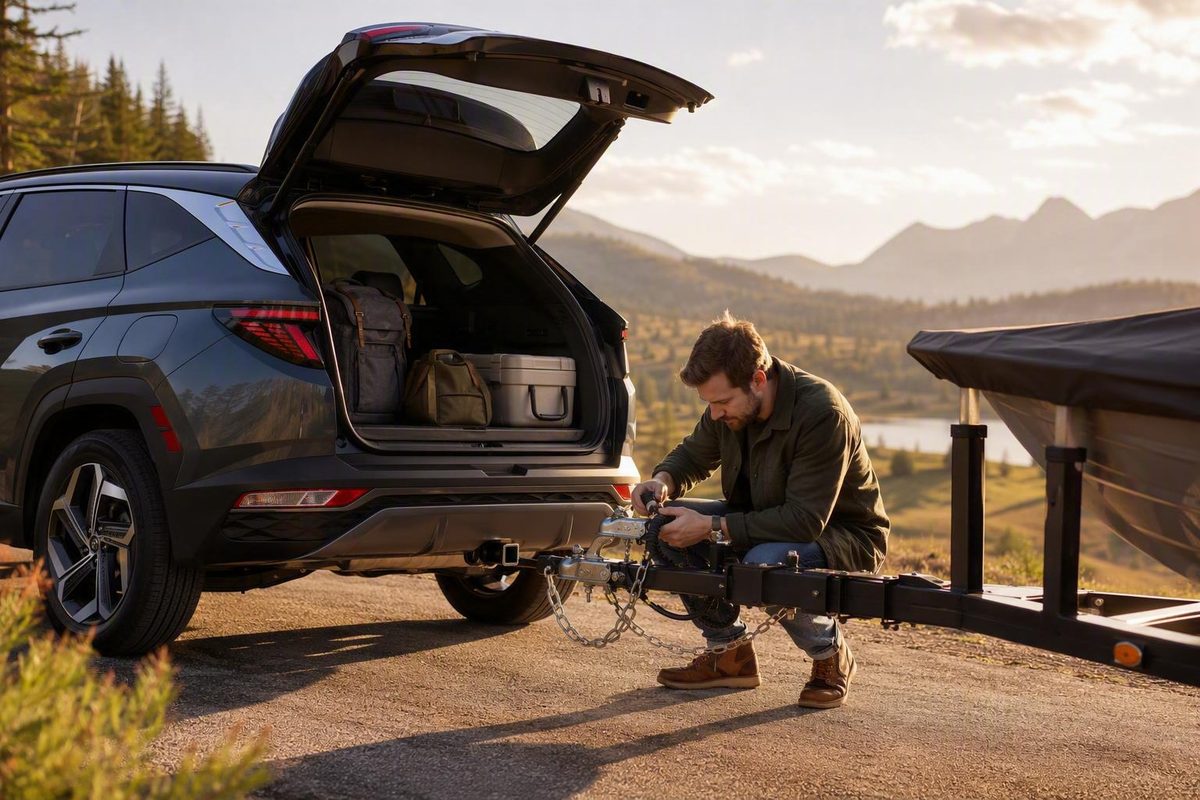
No—do not tow on public roads if Hyundai Recall 290 has removed or disabled your Tucson’s Mobis tow-hitch wiring and the trailer’s required lights no longer work. The receiver may remain usable mechanically, but that does not make the combination road-ready. The current remedy described in owner notices removes the affected harness and caps the receptacle rather than installing replacement wiring, so towing must wait until compatible electrical functions are restored and tested.
Choose your current recall and towing situation; the tool shows the viable paths, unknown costs, and checks required before departure.
Start by identifying the harness. The result updates as you answer; a visible receiver does not establish recall status.
Checks Required For This Result
- Keep the receiver unused for public-road towing until required trailer lights work.
- Ask whether removal was the final remedy and whether another appointment is expected.
- Get written confirmation before installing wiring that could affect the recall or warranty.
- Test the actual trailer after approved wiring is installed.
Replacement And Towing Paths
Costs and times are shown as — because no verified product prices, labor charges, or availability dates were supplied. Select a sort button to reorganize the paths.
More Columns
| Path | Road-Ready? | Connector / Functions | Cost | What Must Happen |
|---|---|---|---|---|
| Use removed or capped wiring | No | None or unpowered | — | Do not rely on it for trailer lights. |
| Continue using affected Mobis harness | No | Recalled connector and module | — | Complete Recall 290; do not bypass the fire-risk remedy. |
| Wait for revised factory wiring | Conditional | Factory specification not supplied | — | Confirm availability, coverage, installation, and output testing. |
| Install a compatible aftermarket four-pin harness | Conditional | Common trailer-light functions only | — | Verify exact fit, protected power, recall compatibility, and Hyundai’s warranty position. |
| Install a properly designed seven-pin system | Conditional | Functions depend on complete installation | — | Separately verify brakes, breakaway, power, charging, reverse, and lighting circuits. |
| Tow after approved wiring and trailer testing | Yes, subject to ratings and law | All applicable functions verified | — | Confirm recall status, vehicle ratings, trailer functions, and local requirements. |
Sources: NHTSA Recall 25V893; Hyundai Campaign 290; Hyundai owner-letter details supplied for this article; Cars.com and Consumer Reports recall reporting. Unknown costs and times are marked —.
Recall 290 Removes The Affected Wiring, Not Necessarily The Hitch
Hyundai’s owner letters mailed May 11, 2026 describe a remedy for certain 2022–2024 Tucson vehicles equipped with an optional Mobis tow-hitch wiring harness. The dealer removes the affected harness and caps the receptacle. The physical receiver can remain on the vehicle.
That leaves two separate facts: a ball mount may still fit the receiver, but the Tucson may no longer provide running-light, turn-signal, or brake-light output to a trailer. Any electric-brake, breakaway, charging, or auxiliary equipment on the particular setup also requires separate verification.
The recall covers more than 51,000 Tucson SUVs. Water can enter the harness control module, potentially causing trailer lighting to fail or an electrical short that increases fire risk. Cars.com reports the affected population, lighting and short-circuit hazards, parking precaution, and Hyundai contact information.
The reported precaution is to park an affected vehicle outdoors and away from structures until the applicable remedy is complete. That is not a blanket instruction that every affected Tucson must never be driven. Follow the notice and VIN-specific instructions Hyundai provides for the vehicle’s exact repair status.
An Intact Receiver Does Not Make The Tucson Ready To Tow
The receiver and wiring perform different jobs.
| Component | Function | Recall Consequence |
|---|---|---|
| Receiver hitch | Mechanical attachment | May remain installed |
| Wiring harness | Carries lighting signals | May be removed |
| Control module | Interfaces with vehicle circuits | Affected by water intrusion |
| Trailer socket | Connects the trailer plug | May be capped or unpowered |
The receiver connects the trailer through the appropriate hitch hardware. It says nothing about whether the lamps work, whether an installed brake controller remains functional, or whether the recall remedy is complete.
If the connector is capped, missing, disconnected, or unpowered, do not rely on it. A trailer that can be coupled but cannot display its required running, brake, and turn lights is not ready for public-road towing.
Trailer-light and brake requirements vary by jurisdiction and trailer configuration. The supplied evidence does not contain state- or province-specific rules, so it cannot support a universal statement about every trailer. Check the transportation authority for every jurisdiction where the trailer will be used. The applicable legal requirements for trailer lighting remain separate from Hyundai’s mechanical towing ratings.
Confirm That Your VIN And Harness Are Included
Recall 290 does not cover every Tucson from the 2022, 2023, and 2024 model years. It concerns certain vehicles equipped with the optional Mobis tow-hitch wiring harness.
Consumer Reports identifies Mobis part CWF61-AU100 and says the campaign can include that part when installed after the vehicle was purchased. It also reports that recalled wiring may be present even when a Tucson does not currently have a physical receiver hitch. Consumer Reports details the equipment scope, part reference, fires, complaints, and campaign identifiers.
The reported U.S. identifiers are:
- NHTSA 25V893, the principal vehicle recall
- Hyundai 290, the principal Hyundai campaign
- NHTSA 25E091, a related equipment recall
- Hyundai 291, another related Hyundai identifier
Use the full 17-character VIN rather than deciding from the model year, hitch appearance, or a part number alone. The NHTSA vehicle recall data can identify published Tucson campaigns, but Hyundai or an authorized dealer must confirm which campaign and procedure apply to a particular VIN.
Owners outside the United States should use their national recall authority and local Hyundai office. Campaign numbers, procedures, and remedy timing may differ by market.
Do not confuse this campaign with Hyundai’s older tow-hitch wiring recall involving certain 2016–2017 Tucson and 2017 Santa Fe vehicles. The older campaign’s remedy does not establish what should happen to a 2022–2024 Tucson under Recall 290.
Water Intrusion Creates Both Lighting And Fire Risks
The affected harness may have been installed in a way that permits water to enter its control module. The evidence does not show that every covered harness has leaked or that every vehicle has suffered an electrical failure.
If water reaches the module, trailer lighting can fail, increasing crash risk. The module can also short electrically, increasing fire risk. Consumer Reports says Hyundai knew of three related fires and no injuries. It also reports complaints from owners whose trailer brake lights did not work.
Those hazards explain why continuing to use the affected harness is not a reasonable workaround. A connector can look intact while its module no longer provides reliable output. Plugging in a tester once also does not resolve the underlying short-circuit risk identified by the recall.
If a dealer has removed or isolated the harness, ask whether the outdoor-parking precaution still applies in that exact configuration. The supplied evidence does not answer that procedure-specific question. Obtain Hyundai’s answer in writing rather than assuming removal automatically ends every precaution.
Earlier Replacement Reports Do Not Override The Current Notice
Earlier recall reporting described free dealer replacement of the tow-hitch wiring harness. The newer owner-letter remedy described in the topic materials removes the Mobis harness and caps the receptacle rather than replacing it at that visit.
That difference matters. An older article saying “replacement” does not prove that a revised factory harness is available for installation now. Conversely, a completed removal procedure does not prove that the Tucson’s trailer-light function has been restored.
Ask the dealer to document:
- Which campaign was performed against the VIN.
- The service procedure or document number used.
- Which harness, module, connector, fuse, or other parts were removed.
- Whether the receiver remained untouched.
- Whether removal is the final remedy or another appointment is expected.
- Whether Hyundai currently offers revised wiring for that VIN.
- Which trailer outputs, if any, were tested after the work.
- Whether the outdoor-parking instruction still applies.
A dashboard message, owner-app entry, or recall database status marked “complete” is an administrative record. It does not demonstrate that the socket is powered. Read the repair order and test the actual towing system after Hyundai confirms that approved wiring has been installed.
Waiting For Revised Factory Wiring Is The Clearest Path
If towing can wait, the least ambiguous course is to complete Recall 290, retain the paperwork, and ask Hyundai to notify you if revised factory wiring becomes available for the VIN.
The supplied materials do not provide an availability date for a revised harness. They also do not provide a current price because the earlier published remedy was described as free replacement while the current owner-letter procedure is removal and capping. Ask whether any later installation will be covered under the recall and have that answer added to the repair order.
Do not interpret “recall complete” as permission to tow when the connector remains capped. Completion can mean the fire-risk component was removed, not that towing functionality was preserved.
An Aftermarket Four-Pin Harness Requires Vehicle-Specific Approval
An aftermarket four-pin harness may restore the common running-light, left-turn, right-turn, and brake-light functions, but only if the product is explicitly compatible with the exact Tucson configuration and does not reuse the recalled module or compromise the recall repair.
No verified kit list, product price, labor charge, or installation time was supplied for this article. Those figures are therefore shown as — in the decision tool rather than estimated. Obtain written quotes based on the VIN, drivetrain, trim, market, and existing wiring.
Before authorizing an aftermarket installation, ask Hyundai and the installer to confirm:
- Whether adding it affects the completed recall remedy or warranty coverage
- Whether it draws power through an independent protected supply
- Whether it uses or bypasses any recalled component
- Whether it is designed for the Tucson’s vehicle-lighting electronics
- Which trailer functions it supports after installation
- How the socket and module will be mounted and protected from water
A basic four-pin connection does not by itself provide every circuit that may exist on a seven-pin setup. If the trailer has electric brakes, charging, reverse, or auxiliary circuits, those functions need a separately designed and verified installation. Electric trailer brakes and seven-way circuits should not be assumed operational merely because the trailer lamps pass a test.
An aftermarket bypass should not be installed simply to avoid the recall appointment. Resolve the recalled Mobis harness first, preserve the dealer’s documentation, and make sure the new installation does not reconnect or depend upon the defective equipment.
Test The Actual Trailer Before Returning To The Road
After approved wiring is installed, connect the trailer that will actually be towed. Confirm running lights, both turn signals, brake lights, and hazard-light operation. If fitted, separately verify electric brakes, breakaway equipment, charging, reverse, and auxiliary circuits.
Testing only the vehicle socket cannot prove that the trailer’s lamps, grounds, connectors, and wiring are sound. A qualified installer can load-test the outputs and inspect the trailer side when the owner cannot do so safely.
Recall completion also does not establish that a particular trailer is within the Tucson’s ratings. Verify the towing capacity, receiver and ball-mount ratings, tongue-weight limit, loaded trailer weight, tires, axles, and load distribution from the vehicle manual and equipment labels. No towing-capacity figures were supplied here because they can vary by vehicle configuration.
Keep the recall notice, repair order, parts list, service-procedure number, installation invoice, and test results. Those records make it easier for Hyundai, another dealer, or an installer to distinguish the recalled harness from any later approved equipment.
Get A Written Answer If You Need To Tow Soon
Call the dealer with the VIN and repair-order number. Ask whether Recall 290 is open, whether the Mobis harness has been removed, whether the cap is merely protective or marks an unpowered receptacle, and whether Hyundai authorizes any replacement wiring for the current configuration.
Hyundai’s reported U.S. recall contact number is 855-371-9460. Have the mileage, repair date, dealer name, photos of the socket area, and details of the trailer’s lighting and braking equipment ready.
If the dealer cannot reconcile a “complete” campaign status with a dead trailer socket, escalate through Hyundai’s recall channel. Request a written statement identifying whether another factory repair is planned and whether an aftermarket installation would affect the campaign or warranty.
Until suitable wiring is installed and the actual trailer passes its electrical checks, leave the trailer unhitched for public-road travel. The receiver’s presence means only that a mechanical connection remains possible; it does not replace the lighting, braking, rating, and legal checks required for the complete towing setup.