
6 min read ·
Check the Recall Before Touching the 7-Way Plug
Brake lights stuck on or an ESC warning while towing? See why bZ Woodland owners should check recall 26V512000 before testing the trailer plug.
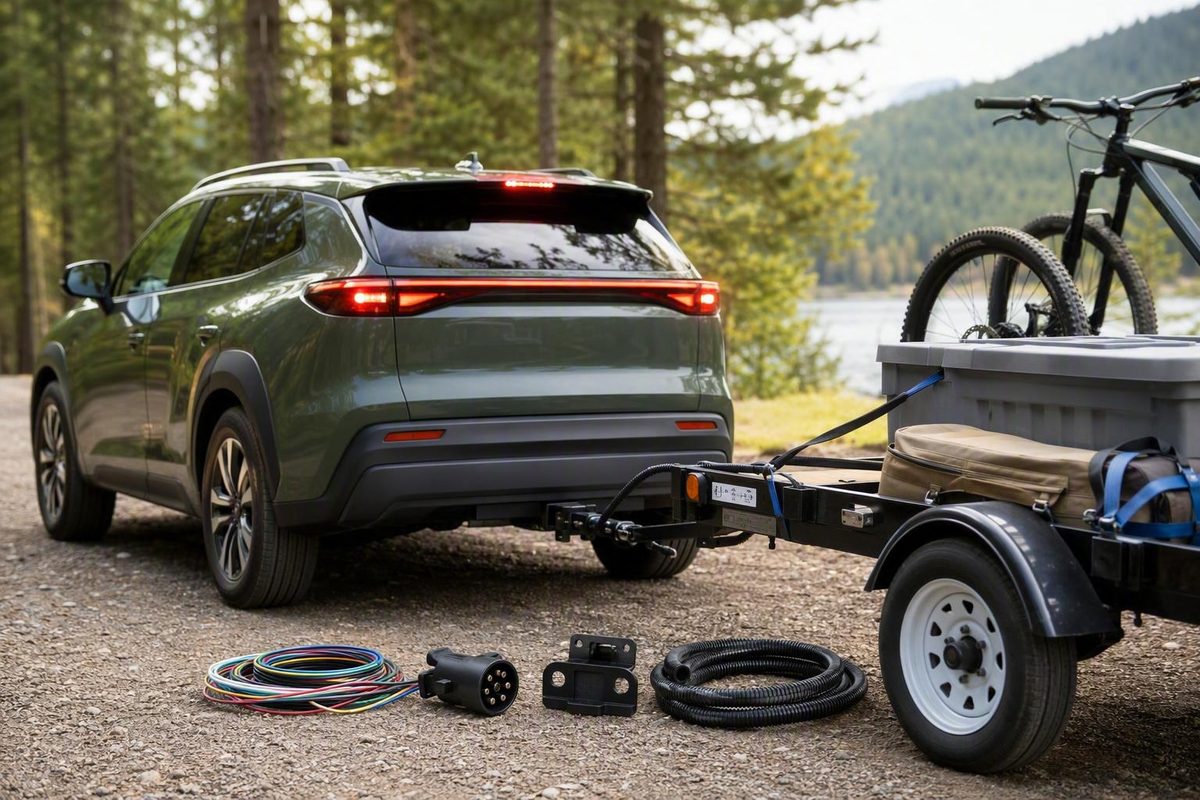
For the 407 vehicles potentially covered by Toyota recall 26V512000, checking the 7-way connector is the wrong first move when brake lights remain on or electronic stability control deactivates. Toyota reported that the short may occur inside the tow converter’s printed circuit board, and its specified fix is replacement of that module—not cleaning connector pins, repairing a ground, repinning a harness, or installing software (NHTSA campaign 26V512000).
This is a narrow verdict. It applies to certain 2026 Toyota bZ Woodland vehicles equipped with a tow converter, not every bZ Woodland and not every trailer-light problem. The 407 figure is the potential campaign population, not the number of converters confirmed to have failed.
The Usual 7-Way Advice Is Generally Sound
Most trailer-wiring guides begin at the connector for good reason. Corroded pins, a poor ground, and a chafed harness can interrupt trailer lamps or create erratic lighting behavior. When the complaint is simply that trailer lights are out, those remain sensible places to inspect.
That received wisdom does not fit the two symptoms named in this recall. NHTSA says an electrical short may occur within the tow converter printed circuit board, potentially deactivating electronic stability control and leaving the vehicle’s brake lights illuminated. Those are vehicle-level symptoms attributed to an internal module fault, not evidence that the trailer plug needs cleaning.
The remedy reinforces the diagnosis. Toyota dealers are to replace the tow converter free of charge. The campaign does not prescribe a connector repair, harness rework, software update, owner inspection, or reset (NHTSA campaign record).
The recall also connects two symptoms that a conventional troubleshooting process might treat separately. The vehicles may fail to comply with FMVSS 126, covering electronic stability control, and FMVSS 108, covering lamps and related equipment. One internal converter-board short can therefore appear as both a stability-control problem and a brake-light problem.
Choose the vehicle, symptom, and tow-converter status; the result identifies whether the recall route or connector-diagnostic route wins.
This tool separates the two symptoms named in campaign 26V512000 from an ordinary trailer-light complaint. It cannot determine recall eligibility; only a VIN or U.S. plate lookup can do that.
A 2026 bZ Woodland with a tow converter and brake lights that remain illuminated matches the vehicle, equipment, and one of the consequences named in campaign 26V512000.
- Do not begin by opening the converter or altering the 7-way wiring.
- Check the complete VIN or U.S. license plate for NHTSA campaign 26V512000.
- If open, call a Toyota dealer for free tow-converter replacement and request vehicle-specific guidance.
All Decision Paths
| Vehicle | Converter | Symptom | Winning Route |
|---|---|---|---|
| 2026 bZ Woodland | Yes | Brake lights remain on | Recall: Check VIN; dealer replacement if open. |
| 2026 bZ Woodland | Yes | ESC warning/deactivation | Recall: Check VIN; dealer replacement if open. |
| 2026 bZ Woodland | Yes | Trailer lights out | Connector diagnosis plus VIN check: Recall does not name lamp outage alone. |
| 2026 bZ Woodland | No | Brake lights remain on | Vehicle service: Equipment does not match; seek dealer diagnosis. |
| 2026 bZ Woodland | No | ESC warning/deactivation | Vehicle service: Equipment does not match; seek dealer diagnosis. |
| 2026 bZ Woodland | No | Trailer lights out | Connector route: Check pins, ground, and harness. |
| 2026 bZ Woodland | Unknown | Brake lights remain on | Verify equipment and VIN: Do not assume the recall is excluded. |
| 2026 bZ Woodland | Unknown | ESC warning/deactivation | Verify equipment and VIN: Do not assume the recall is excluded. |
| 2026 bZ Woodland | Unknown | Trailer lights out | Connector diagnosis plus VIN check: Establish converter and recall status. |
| Other vehicle/year | Yes | Brake lights remain on | Vehicle service: 26V512000 does not match these inputs. |
| Other vehicle/year | Yes | ESC warning/deactivation | Vehicle service: 26V512000 does not match these inputs. |
| Other vehicle/year | Yes | Trailer lights out | Connector route: Check pins, ground, and harness. |
| Other vehicle/year | No | Brake lights remain on | Vehicle service: 26V512000 does not match these inputs. |
| Other vehicle/year | No | ESC warning/deactivation | Vehicle service: 26V512000 does not match these inputs. |
| Other vehicle/year | No | Trailer lights out | Connector route: Check pins, ground, and harness. |
| Other vehicle/year | Unknown | Brake lights remain on | Vehicle service: Identify equipment; 26V512000 does not match. |
| Other vehicle/year | Unknown | ESC warning/deactivation | Vehicle service: Identify equipment; 26V512000 does not match. |
| Other vehicle/year | Unknown | Trailer lights out | Connector route: Identify equipment, then check pins, ground, and harness. |
Source: NHTSA campaign 26V512000 and NHTSA’s 2026 Toyota bZ Woodland recall record. The campaign lists an internal tow-converter PCB short, 407 potentially affected vehicles, ESC and brake-light consequences, and dealer replacement as the remedy.
A VIN Check Comes Before Electrical Testing
Campaign 26V512000 covers certain 2026 Toyota bZ Woodland vehicles equipped with a tow converter. Model and model year alone cannot establish whether a particular vehicle is included. NHTSA’s model-level result for the 2026 bZ Woodland confirms the campaign and affected configuration, but it cannot show whether the recall remains open on one specific vehicle.
Use the complete 17-character VIN or a U.S. license plate in NHTSA’s official recall lookup. Look for NHTSA campaign 26V512000 or Toyota campaign 26TB15/26TA15. Save the result and give the VIN and campaign number to the Toyota dealer.
Do not infer recall status from a visible hitch, trailer connector, seller’s towing-package description, reported build date, absence of symptoms, or the fact that the vehicle has never towed. The supplied official summaries do not provide a production window, affected part number, component supplier, or visual identification method that owners can use as an eligibility test.
A result showing no open recall can mean the vehicle was not included or that the repair has already been completed. When buying a used or dealer-held vehicle, request the VIN before purchase and ask for the repair order if the seller says the campaign was completed.
The 407-Vehicle Figure Describes Scope, Not Failures
NHTSA lists 407 as the potential number of units affected. That does not mean 407 tow converters have shorted, 407 owners have reported symptoms, or 407 vehicles have experienced both consequences.
The small population matters because it limits the claim that can be made from this recall. Campaign 26V512000 identifies a specific manufacturing defect affecting certain equipped vehicles. It does not show that the 7-way connector standard is defective, that all bZ Woodland tow converters are faulty, or that internal converter shorts are the usual cause of trailer-light trouble.
Within that limited population, however, the official failure point is unambiguous: an electrical short may occur in the tow converter’s printed circuit board. Classic connector checks cannot repair that board.
The Reported Symptoms Require Dealer Guidance
Continuously illuminated brake lights can make it harder for following traffic to distinguish actual braking from normal travel. Deactivated electronic stability control means that assistance may not be available when it otherwise would have intervened. NHTSA identifies both outcomes as increasing crash risk.
The wording remains conditional. The short may occur, stability control may deactivate, and the brake lights may remain illuminated. The recall does not say every covered converter will fail or that every failure will produce both symptoms.
An absence of symptoms does not exclude a vehicle from the campaign. Conversely, brake-light or stability-control symptoms do not prove that a vehicle is included. Recall eligibility comes from the vehicle record.
If the brake lights remain illuminated or stability control appears unavailable, contact a Toyota dealer for guidance specific to the vehicle. The official summaries do not establish a universal procedure for continuing to drive or tow with either symptom.
The campaign record lists no park-it warning and no outside-parking warning. That database status should not be interpreted as a guarantee that driving or towing before repair is risk-free.
The Free Fix Is Converter Replacement
Toyota’s remedy is dealer replacement of the tow converter at no charge. It is a physical component replacement, not an over-the-air update, software reflash, battery-management change, connector re-pin, or general trailer-wiring repair.
When scheduling, provide the VIN and reference NHTSA 26V512000 and Toyota 26TB15/26TA15. Confirm that the dealer can verify the open campaign and ask about parts and intake arrangements. The available evidence does not state how long the replacement takes or whether every dealer currently has a converter available.
Keep the repair order after the work is completed. A receipt for unrelated trailer wiring, connector cleaning, or harness work does not document completion of this recall.
For unresolved questions about eligibility or campaign status, Toyota customer service is 1-800-331-4331.
The Recall Is Not a High-Voltage Battery Campaign
NHTSA categorizes the affected component under the electrical system, but that broad classification does not make this a high-voltage propulsion recall. Campaign 26V512000 is not described as a defect in the traction battery, battery enclosure, charging inlet, motors, inverter, high-voltage cables, or battery-control software.
The tow converter is associated with the trailer-lighting interface. The official record does not disclose the precise internal path by which the printed-circuit-board short affects brake-light operation or stability control. Claims about a particular transistor, relay, wire, controller input, or communications bus would therefore be speculative.
The record also does not say that a trailer must be connected for the condition to occur. Disconnecting the trailer, avoiding towing, or never having towed does not establish that a covered vehicle is free of the defect.
Do not open, bypass, solder, disconnect, or modify the converter in place of the recall remedy. An owner-designed wiring alteration is not Toyota’s specified repair.
Trailer Lights Alone Still Point Toward the Connector
The recall does not name ordinary trailer-lamp failure as its reported consequence. If the only symptom is that a trailer’s lights do not work, and the vehicle’s brake lights and stability control behave normally, the campaign record does not establish that the converter PCB is responsible.
That is where conventional diagnosis retains its value. Corroded 7-way contacts, a poor ground, and chafed wiring remain plausible causes of trailer-light problems. The recall does not overturn those checks for unrelated vehicles or unrelated symptoms.
A 2026 bZ Woodland equipped with a tow converter should still receive a VIN check, even when its only complaint is trailer lights being out. The check determines recall status; it does not automatically diagnose the lamp fault. If campaign 26V512000 is open, arrange the free replacement rather than treating connector maintenance as recall completion.
Owner Letters Do Not Need to Arrive First
NHTSA received Toyota’s report on August 6, 2026. Owner-notification letters were expected to be mailed September 21, 2026, according to the official campaign record. That date describes the expected mailing schedule, not proof that a particular owner has received notice.
Owners and prospective buyers do not need to wait for postal mail. Check the VIN or U.S. license plate now, save the result, and contact a Toyota dealer if campaign 26V512000 is open.
The supplied summaries do not state how many incidents, warranty claims, crashes, or injuries are associated with the condition. They also do not specify warning messages, diagnostic codes, repair duration, current parts availability, or whether the fault can occur without a trailer attached. Those unanswered points should come from Toyota or the servicing dealer, not assumptions based on generic trailer-wiring behavior.