
12 min read ·
How to Choose a Military Connector Without Trusting the Label
Start with the governing specification; verify the full part number, current QPD status when required, mating pair, accessories and tooling.
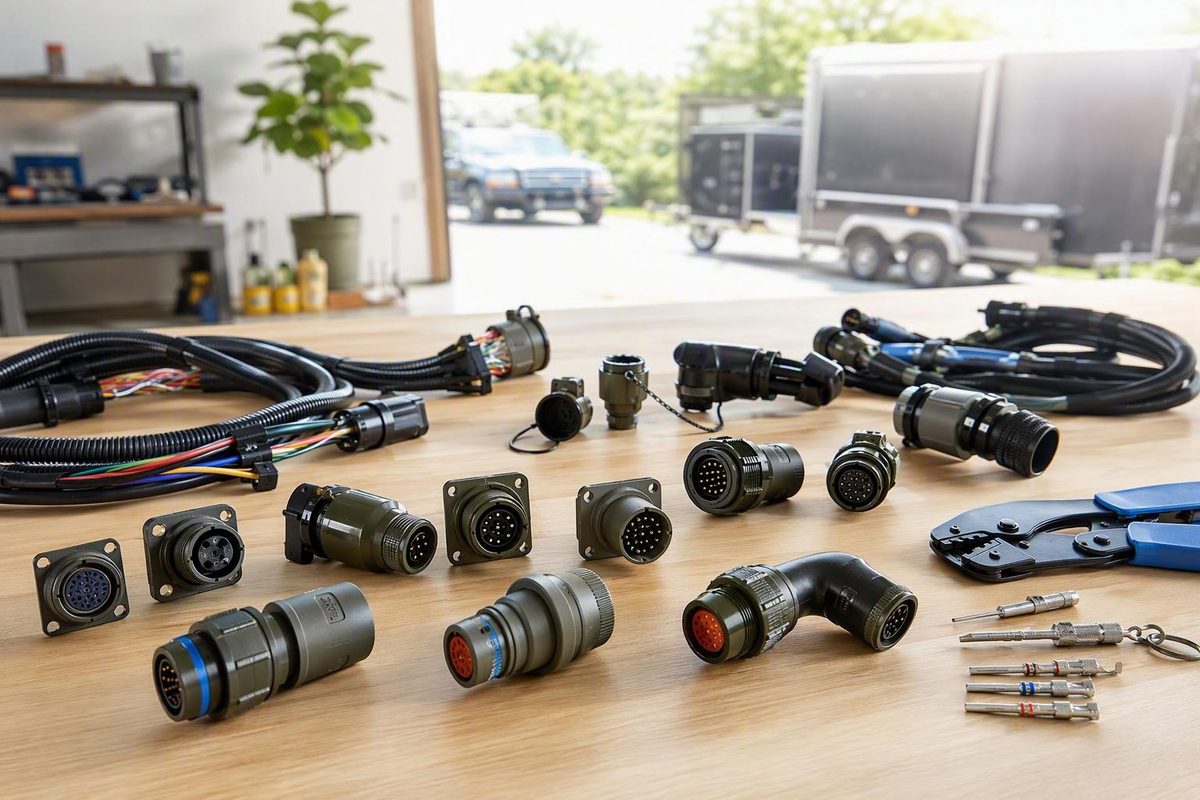
Choose mil spec electrical connectors by starting with the named governing specification and the application—not appearance, seller wording, price, or reviews. Before ordering, verify the complete manufacturer part number and current qualification status when required, prove that the plug and receptacle mate, and identify every contact, seal, accessory, and tool needed for installation.
That process creates a defensible shortlist, not final engineering approval. Exact ratings and suitability must come from the current controlling specification, documentation for the exact configuration, and the responsible engineer or procurement authority.
Start here: the seven-step selection and verification checklist
-
Define the circuit and environment. Record voltage, current and required derating, wire size, signal or data type, circuit count, temperature, moisture, shock, vibration, corrosion exposure, EMI needs, mating frequency, disconnect speed, available space, and procurement requirements.
-
Identify a plausible connector family. Decide whether the application points toward a high-density circular, miniature quick-disconnect, heavy-power, D-sub, Micro-D, nanominiature, audio, or another format.
-
Choose the exact configuration. Resolve the specification, series or class, shell style and size, insert arrangement, contact sizes, pin/socket configuration, keying or polarization, finish, termination method, and accessory interface.
-
Confirm the mating pair. Check both complete part numbers against the controlling nomenclature, interface drawing, or explicit manufacturer mating data. Similar shells and family names are not enough.
-
Identify all accessories and tools. Account for contacts, cavity plugs, backshells, boots, strain relief, shield hardware, cable, protective caps, crimp tooling, locators or positioners, and insertion/removal tools.
-
Verify qualification. If formal qualification is required, match the exact manufacturer and product designation to the applicable current DLA Qualified Products Database record. Do not transfer qualification from another product made by the same company.
-
Retain dated procurement records. Save the QPD result and check date, current datasheet, supplier quotation, complete ordered part numbers, included-component list, certificates, traceability records, and approved deviations.
| Requirement | Question to answer | Document to check | Risk if omitted |
|---|---|---|---|
| Electrical | What voltage, current, derating, wire size, and signal type apply? | Controlling specification and exact-part datasheet | Electrical suitability remains unverified |
| Environment | What temperature, moisture, vibration, shock, corrosion, and EMI conditions apply? | System requirement, specification, and applicable test data | Environmental suitability remains unverified |
| Mechanical | What coupling, shell size, keying, space, and disconnect speed are needed? | Interface drawing and manufacturer catalog | Mating or installation may be incompatible |
| Procurement | Is qualification, traceability, or an approved source required? | Contract, drawing, QPD record, and supplier documents | Material may not meet purchasing requirements |
| Installation | Which contacts, seals, accessories, wire, and tools are required? | Assembly instructions and bill of materials | The ordered system may be incomplete or unbuildable |
Treat the connector as a system rather than a shell. Contacts form the electrical interface; inserts, interfacial seals, rear grommets, and cavity plugs affect isolation and sealing; backshells, boots, and strain relief manage the cable exit; shield hardware affects EMI termination; and cable dimensions and tooling determine whether the assembly can be built as specified.
What “MIL-spec” does—and does not—prove
“Mil-spec” can refer to materially different products:
- Claimed-compliant product: A supplier says the product meets a specification, but qualification may not be required or independently established.
- Commercial derivative or “38999-style” product: The design is based on a military family but may use different materials, dimensions, contacts, finishes, or performance limits.
- Mil-style product: The label describes appearance or market positioning without identifying a controlling specification and supporting evidence.
These categories are not interchangeable. A derivative may be suitable for a commercial harness, but it should be purchased and documented as a derivative rather than silently treated as a qualified military item.
A family description also does not qualify every available configuration. Shell material, finish, insert, contacts, termination, class, and special modifications can change performance or approval status. Check the complete part number instead of relying on manufacturer reputation, stock status, price, reviews, kit branding, or rugged appearance.
For example, one retailer offers high-density products labeled as “MIL-Spec Connector Kits” in multiple position counts, shell sizes, contact sizes, and colors. The captured listing did not identify a governing military specification, complete manufacturer part numbers, qualification records, or electrical and environmental ratings. It is therefore a shopping lead, not evidence that an exact kit is qualified.
The same boundary applies to assembly advice. Plug It Right’s Deutsch DT kit and crimping guide covers practical kit contents, crimping, contact seating, and sealing, but it does not identify DT as compliant with a military specification. Good workmanship does not create qualification status.
Major connector families at a glance
Use this comparison to identify a specification worth investigating, not to select an exact part. Every description is at family level.
| Family | Physical format or coupling | Broad use case | Cautions |
|---|---|---|---|
| MIL-DTL-38999 | High-density, environmentally resistant circular; Series I and II generally use bayonet coupling, Series III threaded coupling, and Series IV breech coupling | Harsh-environment power, signal, data, and mixed interfaces | Resolve series, insert, contacts, keying, shell material, finish, and qualification |
| MIL-DTL-26482 | Miniature, environment-resistant, quick-disconnect circular | Compact equipment requiring a quick-disconnect interface | Use MIL-DTL-26482 unless controlling documents specify another designation |
| MIL-DTL-83723 | Circular family with configurations described for general-purpose, high-temperature, and firewall applications | Equipment requiring a class associated with a particular environment | A class description does not establish an exact part’s limits |
| MIL-DTL-22992 | Heavy-duty power and control family | Larger power and control circuits; Class L is described for 40–200 A applications | Do not apply the Class L range to every class or product |
| MIL-DTL-24308 | Polarized-shell D-sub format | Compact multipin equipment interfaces | Verify the exact contact, shell, termination, and environmental configuration |
| MIL-DTL-32139 | Nanominiature format | Low-power, highly miniaturized interconnections | Wire, assembly, and tooling constraints may control selection |
| MIL-DTL-55116 | Miniature audio connector family | Radio and related audio interfaces | The intended interface and pin arrangement must match the equipment |
| MIL-DTL-83513 | Polarized Micro-D rectangular format | Dense, compact signal interconnections | Verify the exact termination and contact construction |
| MIL-DTL-5015 | Legacy threaded circular family | Power, control, and established equipment interfaces | Check the contract, equipment drawing, approved-parts list, and current procurement record |
The MIL-DTL-38999 coupling distinctions and the MIL-DTL-22992 Class L range are summarized in Amphenol’s military circular connector overview. The descriptions of the D-sub, nanominiature, audio, Micro-D, and legacy threaded families are summarized in a secondary overview of U.S. military connector specifications; use the current controlling specification for procurement decisions.
For miniature quick-disconnect circular applications, investigate MIL-DTL-26482. For general-purpose, high-temperature, or firewall classes, investigate MIL-DTL-83723. For heavy power, investigate MIL-DTL-22992 and then the required class.
MIL-DTL-5015 still appears in catalogs and installed systems. Do not declare every existing 5015 interface obsolete or unsuitable. Determine which specification, drawing, or approved-parts requirement governs the actual job.
How to verify qualification in the DLA database
When a purchase requires a qualified product:
- Capture the governing specification. Record its full designation and any required series, class, slash sheet, amendment, or revision-sensitive detail.
- Capture the exact product identity. Obtain the manufacturer’s database-listed or legal name and the complete manufacturer part number.
- Open the applicable official qualification record. Use the DLA record for the relevant specification and follow its Qualified Products Database access.
- Compare manufacturer and product information. Finding the company, a similar base number, or another product in the family is not an exact match.
- Resolve suffixes and ranges. If the database does not reproduce the distributor’s ordering number verbatim, require documentation mapping the ordered configuration to the qualified designation. Do not make that mapping from appearance.
- Investigate discrepancies. Ask about finishes, suffixes, special modifications, manufacturing locations, or distributor-created SKUs before accepting a match.
- Record the result and date. Save a dated export, printout, screenshot, or controlled purchasing record.
- Retain supporting documents. Keep the current exact-part datasheet, supplier quotation, certificates, traceability information, and purchase description.
For MIL-DTL-38999, the official DLA QPL-38999 document record identifies MIL-DTL-38999 as the governing specification and states that the former document-based qualified-products list was transformed into an electronic list in the Qualified Products Database. Use the applicable live QPD result on the procurement date; a historical list or old datasheet is not a substitute.
The available evidence here does not include individual QPD manufacturer or product entries, so no particular connector can be identified as currently qualified. A manufacturer may sell qualified configurations beside custom products and specification-inspired derivatives.
Request the following from the supplier:
- Governing specification and applicable series or class
- Complete manufacturer part number
- Actual manufacturer identity, not only a distributor or kit brand
- Current QPD evidence when qualification is required
- Current exact-part datasheet or catalog drawing
- Itemized list of included components
- Required lot, batch, certificate, and authorized-channel traceability
If the supplier cannot connect its SKU to the exact manufacturer designation and applicable qualification record, the status remains unresolved.
Decode the part number and prove the two halves mate
Before approving a plug and receptacle, compare:
- Specification and series or class
- Coupling interface
- Shell style and shell size
- Insert arrangement
- Contact size and quantity
- Pin or socket configuration
- Keying, clocking, and polarization
- Termination type
- Accessory interface, including backshell attachment
- Finish or material where it affects the interface or procurement
Part-number grammar varies by specification and manufacturer. Never apply a code learned from one retailer or connector family to another.
As a limited example, one retailer’s connector nomenclature guide says its connector types 3470 and 3474 mate with 3476 but not with each other. In that seller’s scheme, the following two digits identify shell size, while the final number and letter identify terminal configuration and whether the contacts are pins or sockets. P means pin and S means socket within that scheme only.
Shell size may help identify a backshell, but a shared size label does not prove accessory compatibility. Confirm the attachment interface, orientation, cable-entry size, shield-termination method, and approved combination for the complete connector number.
The controlling nomenclature, interface drawing, approved cross-reference, or explicit manufacturer mating data must connect the two complete part numbers.
Plan the complete installation before ordering
Build the bill of materials before buying the housing.
Connector-system checklist
- Plug
- Receptacle
- Correct pin contacts
- Correct socket contacts
- Cavity sealing plugs where required
- Backshell
- Boot
- Strain relief
- Shield-termination hardware
- Correct cable or individual wires
- Protective or dust caps where required
Tooling checklist
- Approved crimp tool
- Correct locator
- Turret head or positioner
- Insertion tool
- Removal tool
- Wire stripper
- Shield-band installation tool, if specified
- Required inspection and test equipment
Do not assume that every family uses all three or that visually compatible parts create an approved stack.
Contacts require equally precise classification. Crimp and solder describe termination methods; removable and fixed describe whether the contact can be taken out after installation. These are separate characteristics.
For example, Amphenol Socapex states that PT/451 solder contacts are supplied installed and cannot be removed. Its assembly resource for military circular connectors also describes the 2M contact procedure as identical to its MIL-DTL-38999 procedure while specifying different tools. Similar procedure does not mean interchangeable tooling.
Finally, verify what “kit” means. The word does not establish that contacts, cavity plugs, seals, backshells, boots, caps, or tools are included. Require an itemized contents list tied to the exact kit SKU.
Crimp, insert, seal, and inspect to the product instructions
At a high level, correct assembly follows this sequence:
- Confirm the current instructions, contact, wire range, strip dimension, and tool setup for the exact product.
- Strip the conductor to the specified length without cutting or nicking strands.
- Insert the conductor fully into the contact.
- Crimp with the specified tool, locator, turret head, or positioner setting.
- Perform the required visual and mechanical inspection.
- Insert the contact until its retention feature engages.
- Verify seating and retention as instructed.
- Install sealing plugs in unused cavities where required.
- Fit the backshell, strain relief, boot, and shielding hardware in the specified order.
- Complete the required continuity, insulation, sealing, or other acceptance checks.
Amphenol Series Five provides a product-specific example, not a universal recipe. Its Series Five assembly instructions require the wire to be visible through the contact inspection hole before and after crimping. They direct the assembler to choose the appropriate M22520-series tool and required locator, turret head, or positioner according to contact and wire size.
For that product, the plastic contact tool is double-ended: the colored end is for insertion and the white end for removal. The instructions also require empty cavities to receive wire sealing plugs.
Do not copy Series Five strip dimensions, tool references, or inspection details into another connector family’s process. Use the current instructions for the exact product. General workmanship principles—matching the tool and wire to the contact, seating contacts fully, checking retention, and closing unused cavities—do not replace a family-specific assembly procedure.
A purchase-screening worksheet for supplier claims
Copy this worksheet into the request for quotation, purchasing file, or build record:
Application:
Governing specification:
Required revision/amendment:
Series or class:
Full manufacturer part number:
Manufacturer identity:
QPD result:
QPD check date:
Plug part number:
Receptacle mate part number:
Mating evidence/source:
Shell style and size:
Insert arrangement:
Contact sizes and quantities:
Pin/socket configuration:
Wire range:
Termination type:
Voltage/current/derating source:
Environmental ratings source:
Shell material and finish:
Keying/polarization:
Backshell/accessory interface:
Required seals or cavity plugs:
Required backshell/boot/strain relief:
Required shield hardware:
Required crimp tool:
Required locator/turret head/positioner:
Required insertion/removal tools:
Included kit components:
Separately ordered components:
Authorized-channel or traceability documents:
Certificates required:
Unresolved questions:
Approval name/date:
Pause the purchase if any of these red flags appears:
- No named governing specification
- No complete manufacturer part number
- Seller SKU offered in place of manufacturer identity
- Qualification inferred from price, reviews, stock, appearance, or reputation
- “Qualified,” “compliant,” “style,” and “equivalent” used interchangeably
- Family-wide ratings applied to every variant
- Claimed substitute without an interface drawing or approved cross-reference
- Kit contents shown only in photographs
- Tooling described as “standard” without contact- and wire-specific details
- Finish superiority asserted without evidence relevant to the application
For example, the claim that black zinc nickel is categorically superior to electroless nickel is too broad to use as a selection rule. A defensible comparison must address the application’s corrosion exposure, conductivity and bonding needs, wear or mating durability, galvanic compatibility, material restrictions, and specification requirements.
The stop rule is simple: do not order while qualification, exact ratings, mating compatibility, or tool requirements remain unresolved. Name the specification, confirm the exact part and current qualification when required, prove the mating configuration, and identify every accessory and tool. If any check fails, the product is not yet a defensible selection—regardless of how rugged it looks or how confidently it is labeled.
Are MIL-DTL-38999 connectors from different manufacturers automatically interchangeable?
No. Series, coupling, shell style and size, insert arrangement, contacts, keying, and polarization must match. Verify the complete part numbers in the controlling documentation and separately confirm accessory fit, required performance, procurement approval, and any manufacturer restrictions.
Is a hermetic connector the same as a sealed environmental connector?
No. The available family summaries distinguish moisture-resistant environmental sealing from hermetic construction; the terms are not interchangeable. Some military connector families include both environmental and hermetic configurations. Check the exact specification and product documentation for the sealing or hermetic requirement that applies to the installation.
Are Deutsch DT connectors mil-spec?
Do not treat Deutsch DT connectors as mil-spec without a named military specification and exact-part evidence supporting that status. Plug It Right’s DT article covers kit contents and assembly workmanship but cites no military specification for the DT family. Evaluate an exact DT product against the ratings and requirements of its intended application rather than relabeling it as military-qualified.