
9 min read ·
The Adapter Logo Matters Less Than Its Amp Rating
A melted R2 adapter pin makes current capacity the key check. Compare the reported 630 A maximum with documented ratings and thermal protection.
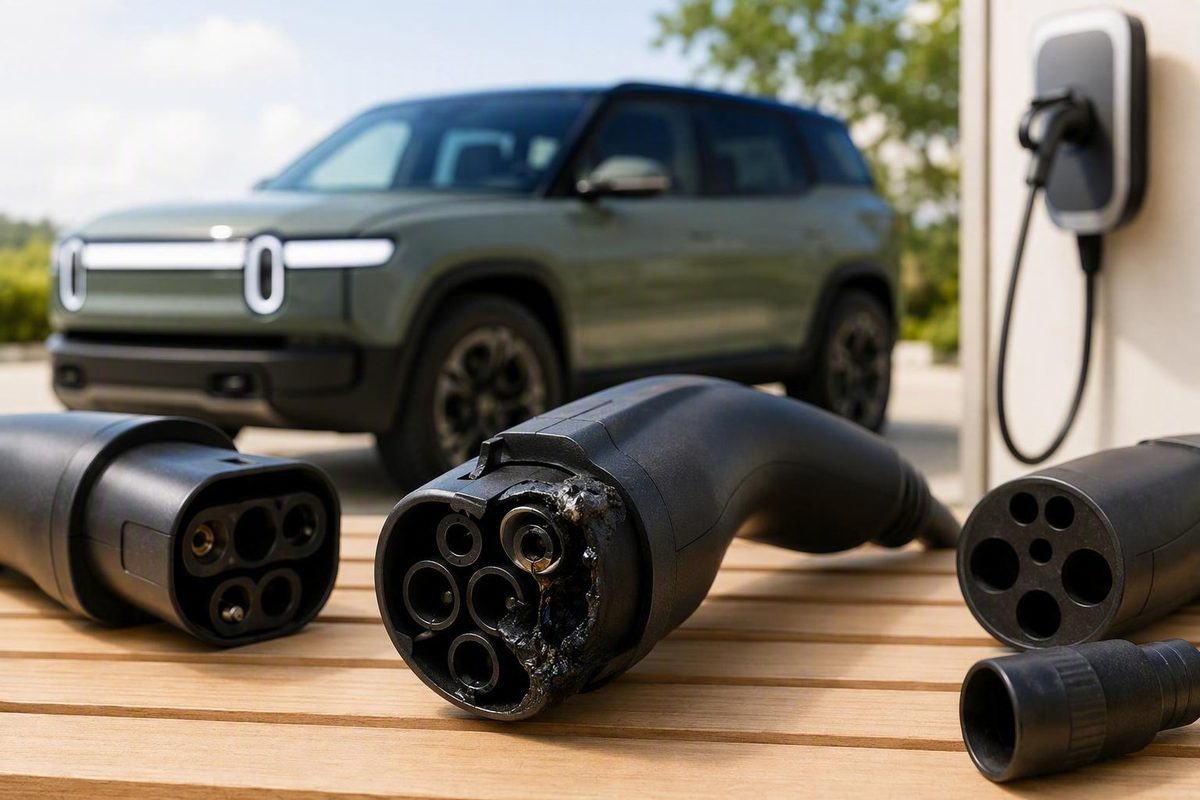
The verdict is to treat the Rivian R2 adapter incident as a current-rating and thermal-protection problem, not a verdict on one brand. The R2 can reportedly accept up to 630 amps, while one older CCS1-to-NACS adapter suffered a melted DC pin during a high-current test. That does not prove amperage alone caused the damage, but it does make an adapter’s documented continuous-current rating and thermal response more useful than its logo.
The damage was found on the adapter’s CCS1 side, not in the R2’s native NACS inlet. The session completed, and no fire or injury was reported. No published current trace, temperature record or teardown established the initiating fault. AutoGuide reports the damaged pin and suspected role of high current.
That distinction limits the claim. The incident does not establish that every older adapter will melt, that every adapter without a thermistor is unsafe in every use, or that the R2 has a general charging-port defect. It shows why physical fit is not an adequate compatibility test when a vehicle can request substantially more current than older hardware may have been designed to carry.
Enter your vehicle maximum and the adapter’s documented continuous rating; the calculator shows which side wins.
Compare the vehicle’s maximum DC acceptance with the adapter’s documented continuous-current rating. This is a conservative specification screen, not a failure prediction.
The documented rating covers only 79.4% of the vehicle maximum. Do not treat a brand name, physical fit or successful session start as the missing 130 A of continuous capacity.
| Reported Figure | Type | Use In A Compatibility Check | Limitation |
|---|---|---|---|
| 630 A | Vehicle maximum | Upper screening value for the R2 | Not proof of sustained session current |
| 600 A | Charger maximum | Reported limit of the tested CCS1 output | No published current trace |
| ~500 A | Adapter claim | Approximate figure reported for older hardware | Exact unit’s data sheet was not supplied |
| 375 A | Charger maximum | Reported limit of the tested NACS cable | Not a universal NACS rating |
| — | Thermistor threshold | Check exact adapter documentation | No threshold supplied in the evidence |
The I²R figure compares heat at the two entered currents only if resistance is identical; it is not a safe-temperature prediction. Sources: Moloughney’s reported test figures as covered by AutoGuide and EVChargingStations, Rivian connector guidance, and the approximate adapter rating reported by EVCUBE.
The calculator is a conservative specification screen, not a prediction of current in a particular session. Actual current can be limited by the charger, battery state, temperature and charging curve. A red result means the adapter documentation does not cover the vehicle’s reported maximum—not that the vehicle will necessarily draw that maximum continuously or that melting is certain.
Why The Interchangeable-Adapter View Seems Reasonable
The received wisdom is understandable: if a CCS1-to-NACS adapter fits, comes from a familiar manufacturer and starts a charging session, owners tend to regard it as interchangeable with another adapter of the same shape. When something fails, the easy explanation is that a cheap third-party product lost to a genuine branded one.
There is some truth in that view. Manufacturing quality, contact pressure, materials, assembly and service history matter. Certification and vehicle-manufacturer approval also matter. A damaged, contaminated or poorly assembled connector can develop excessive resistance even when its nominal current rating looks adequate.
Brand reputation is not useless; it is simply not an electrical specification. One brand can sell several revisions with different ratings and protective features. An old factory adapter and a current aftermarket adapter cannot be ranked reliably from their logos alone.
The documented event makes that limitation visible. The failed device was described as an older Tesla CCS1-to-NACS adapter. Reporting did not establish its exact model number, serial number, production date, authoritative continuous rating or service history. One outlet described it as approximately 500 amps, but did not provide a data sheet for the exact unit.
The available evidence therefore cannot support the blanket claim that all pre-2026 adapters are undersized, nor does it verify the brief’s suggested approximately 350-amp rating for the failed unit. It supports a narrower rule: if the exact adapter’s continuous rating and thermal behavior are undocumented, its brand cannot fill those gaps.
The Test Used CCS1 To Reach Higher Current
The R2 has a native NACS inlet. Tom Moloughney nevertheless used a CCS1-to-NACS adapter because the tested ABB A400 charger’s CCS1 cable reportedly supported up to 600 amps, while its NACS cable was limited to 375 amps. He was trying to record the strongest charging curve available from that equipment. Moloughney explains the setup and shows the damaged adapter.
The connection path was the ABB charger’s CCS1 cable, the CCS1-to-NACS adapter and the R2’s native NACS inlet. Compared with direct NACS charging, the adapter added one detachable high-current interface.
Moloughney estimated that using the lower-current native NACS cable would have added only about two minutes during that session. That estimate is specific to his test, not a general charging-time promise.
Rivian distinguishes these adapter directions. Model-year 2022–2025 vehicles have CCS charge ports and use a NACS DC adapter at compatible NACS chargers. Starting with model year 2026, Rivian vehicles use native NACS and require a Combo CCS1 DC Adapter when connecting to CCS1 equipment. Rivian explains its connector configurations and compatible networks.
The incident was therefore an adapter-assisted DC fast-charging test. It was not a Level 2 home-charging event, and an R2 does not ordinarily need an adapter at a compatible NACS charger.
The Published Numbers Do Not Prove The Session Current
The charger’s CCS1 output reportedly had a 600-amp maximum. Moloughney said Rivian told him the R2 could accept up to 630 amps. Those are equipment capabilities, not a measured current-versus-time record from the failed session.
| Figure | What It Describes | What It Does Not Prove |
|---|---|---|
| 630 A | Reported R2 acceptance maximum | That 630 A flowed in this test |
| 600 A | Reported CCS1 charger maximum | That 600 A was sustained |
| 375 A | Reported NACS cable limit | A universal NACS limit |
| ~500 A | Outlet’s adapter-rating claim | Exact unit’s verified rating |
No published evidence supplies the duration at each current, contact temperature, voltage drop, resistance across the damaged interface or a synchronized indication of when overheating began. Walmart reportedly intended to inspect the charger connector, but the supplied reporting includes no result.
It is therefore inaccurate to state as fact that the R2 continuously pushed 630 amps through a 500-amp adapter. The charger reportedly could not supply 630 amps, and the adapter figure was not tied to an authoritative specification for the exact unit.
A defensible reconstruction is shorter: the R2 was connected through an older adapter to a high-current CCS1 cable; charging completed; and one DC pin on the adapter’s CCS1 side was later found melted. The exact current at failure and the component in which excessive resistance first developed remain unknown.
A 400-Volt Vehicle Can Demand More Current
Reports characterize the R2 as using an approximately 400-volt architecture. For a given charging power, lower voltage requires more current than a higher-voltage system. Delivering 200 kilowatts at 400 volts requires 500 amps before accounting for changing operating conditions and losses. EVChargingStations summarizes the reported architecture and test figures.
Connector heating follows another basic relationship: heating power equals current squared times resistance. If contact resistance remained constant while current doubled, heat generated at that point would increase fourfold.
That is why current deserves attention even though it does not establish the root cause. A slightly worn or contaminated contact may remain uneventful at lower current and heat rapidly when current rises. Possible sources of elevated resistance include reduced contact pressure, corrosion, incomplete engagement, deformation, prior overheating or damage to the station plug.
None was proven in this case. The visible damage was on the adapter’s CCS1 side, leaving several plausible scenarios: resistance within the adapter contact, imperfect mating with the station plug, pre-existing damage, contamination or high current magnifying an already marginal connection.
Thermistors Reduce Risk But Do Not Add Ampacity
A thermistor measures temperature near a relevant interface. If the charging system recognizes excessive temperature, it can reduce current or stop the session before damage progresses. Reducing current can sharply reduce resistive heating because current is squared in the heating relationship.
Later testing with a Lectron adapter reportedly produced a reduced-charging message as the adapter warmed, with no visible melting. Its post-test inspection had not been completed in the cited account, so that result demonstrates a reported protective response rather than proving universal suitability. RivianTrackr describes the warning and reduced-current response.
A thermistor does not turn a 500-amp continuous rating into 630 amps. It also cannot correct contamination, weak contact pressure or physical damage. It is a second line of defense, not a substitute for documented ampacity.
The same caution applies to claims that older adapters lack thermistors. The failed adapter was reported to lack the newer thermal response, but the evidence does not document every pre-2026 model and revision. Check the exact unit rather than using age as a proxy.
Continuous And Peak Ratings Are Different Specifications
An advertised amperage number is useful only when its conditions are defined. Documentation may distinguish among continuous current, a time-limited peak, ambient-temperature restrictions and limits that depend on liquid-cooled charging cables.
“500 A” does not necessarily mean 500 amps continuously under every condition. “600 A peak” does not mean 600 amps indefinitely. A vehicle’s 630-amp acceptance maximum also does not mean it requests that current throughout every charging session.
The correct comparison starts with the adapter’s continuous-current rating under the documented conditions. If that figure is below the vehicle’s reported maximum, the specification screen shows a deficit. A documented temporary peak may narrow that deficit for a stated duration, but it should not be silently treated as a continuous rating.
The supplied evidence identifies UL 2252 as relevant to this adapter class, but it does not provide a model-specific UL database record for any adapter discussed here. Certification claims should be verified against the exact model and revision. Certification, Rivian approval and sufficient current capacity are related checks, not interchangeable ones.
What R2 Owners Should Verify Before CCS1 Charging
Use current Rivian guidance to confirm that the exact adapter is intended for a native-NACS R2 connecting to a CCS1 DC charger. Do not confuse it with the opposite-direction NACS adapter used by older CCS-equipped Rivians.
Match the model and revision printed on the device to manufacturer documentation. Look for the continuous-current rating, any time-limited peak and duration, temperature restrictions, cooling requirements and documented derating or shutdown behavior. If those details are absent, the specification comparison cannot be completed reliably.
Inspect accessible contacts while the equipment is unenergized. Discoloration, deformation, contamination, looseness or unusual insertion force is reason not to proceed. Visual inspection cannot reveal internal resistance, but obvious damage should remove the unit from service.
During charging, follow vehicle and charger warnings. Do not override a temperature or connector warning to regain charging speed. An unusual hot-plastic odor, visible deformation, repeated connector faults or a plug beginning to stick calls for ending the session through normal controls if that can be done safely and contacting the charging network, Rivian or the adapter manufacturer.
Do not improvise around smoking, fused or severely overheated high-voltage equipment. Keep clear and seek qualified or emergency assistance as conditions require. A melted or visibly damaged adapter should not be reused pending manufacturer or qualified inspection.
Direct native-NACS charging removes the adapter’s additional mating interface when a compatible connector provides acceptable performance. When CCS1 adaptation is necessary, the defensible choice is the exact adapter whose approval, continuous rating and thermal behavior are documented for the intended use—not whichever logo feels safest.
The Report Does Not Establish A General R2 Defect
Only one documented melted-pin incident is supplied. There is no incident rate, recall, R2 service bulletin or set of equivalent independently verified failures in the evidence.
The R2 inlet was not reported damaged. High current is a plausible stressor, but no teardown proved that vehicle current alone initiated the failure. Wear, contamination, incomplete engagement, adapter condition and the charger plug were not ruled out.
The lasting lesson is narrower than the headlines: connector compatibility includes ampacity, duration and thermal protection. A plug that mates and starts charging has passed a mechanical check, not the complete electrical one.