
23 min read ·
Before You Move a Travel Trailer’s Hitch Point Into the Truck Bed
Commercial bolt-on systems exist, but they are not universal adapters, proven cures for sway or ways to increase towing capacity.
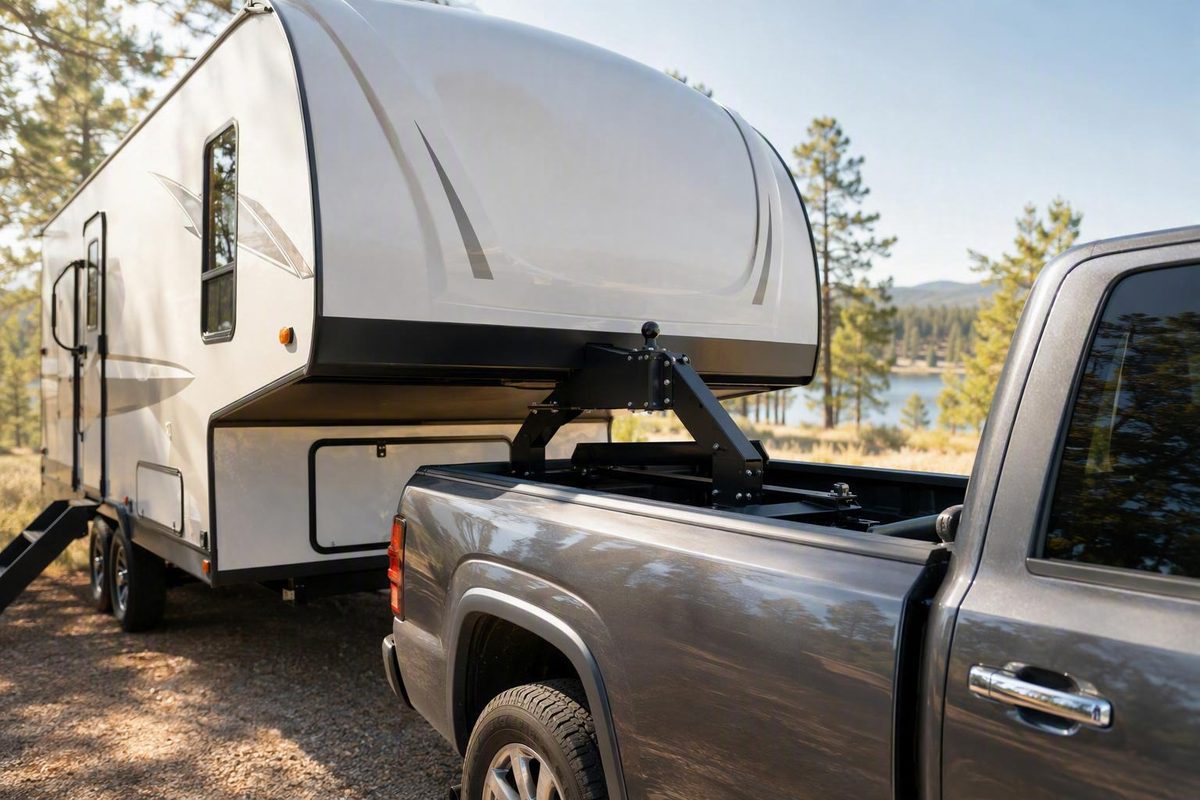
A bumper pull to gooseneck conversion can move a travel trailer’s coupling point from behind the truck into the pickup bed. Commercial bolt-on systems exist, but they are not universal adapters, independently proven cures for sway, or ways to increase towing capacity.
This article is a pre-purchase due-diligence overview, not an engineering approval or a universal installation procedure. The available evidence consists largely of manufacturer pages, retailer listings, promotional coverage, and owner discussions. Structural suitability, installation requirements, and road-use approval must come from the applicable manuals, manufacturers, qualified professionals, insurer, and authorities for the exact combination.
Before buying or fabricating anything, establish five points:
- The trailer’s exact tongue geometry matches the proposed equipment.
- Every truck, trailer, hitch, axle, tire, brake, coupler, and adapter rating remains adequate.
- The trailer or frame manufacturer—or a qualified trailer engineer—accepts the altered load path and attachment method.
- The combination has enough payload and measured articulation clearance.
- The relevant manufacturers, insurer, installer or engineer, and authorities accept the proposed arrangement.
If any point remains unresolved, do not proceed with the conversion. Retain or correct a documented conventional setup while obtaining the missing information.
What a bumper-pull-to-gooseneck conversion actually changes
A bumper-pull connection places the trailer coupler on a ball behind the tow vehicle. The ball may be carried by a receiver-mounted ball mount rather than the bumper itself, but “bumper pull” remains the conventional shorthand.
A gooseneck connection uses a coupler attached to a ball installed in a pickup bed, normally near the rear axle. The commercial products documented here do not turn the travel trailer into a purpose-built gooseneck trailer. They retain its existing A-frame tongue and add a structure that extends forward and upward over the truck bed.
The arrangement can be visualized as follows:
Original bumper-pull arrangement

[ Pickup truck ]----rear receiver ball O---[ travel-trailer coupler / A-frame ]


Converted arrangement

[ Pickup cab ][ bed ball O ]
                    |
                    | gooseneck coupler
                 ___|________________
/ conversion structure \
/ \---[ existing coupler / A-frame ]
BP Conversions describes a bolt-on structure that engages the trailer’s existing coupler, reaches over the bed, and connects to an installed gooseneck hitch. Its standard application is described as a travel trailer with a 50-degree A-frame tongue; other arrangements may require purchaser-supplied fitting. The company also describes the system as removable and fully wired. These are manufacturer statements, not independent structural findings. See BP Conversions’ product description and fit qualifications.
Some sellers call this a “fifth-wheel-style” conversion because moving the pivot toward the truck’s rear axle resembles one aspect of fifth-wheel towing. That terminology can obscure the actual hardware. The documented BP arrangement connects to a gooseneck ball, not to a conventional fifth-wheel plate and kingpin.
Moving the pivot can change:
- How the truck and trailer track through turns
- How the trailer responds to steering inputs
- Cab, bed-rail, tailgate, toolbox, and bed-cover clearance
- The amount of usable truck-bed space
- The combination’s effective dimensions
- The route by which towing and vertical loads reach the truck
- The forces transmitted through the adapter, trailer A-frame, and main rails
Those effects cannot be quantified for a specific combination from the product pages alone.
Changing the coupling location does not increase any published truck payload, gross vehicle weight, axle, tire, hitch, coupler, brake, trailer GVWR, or frame rating. A new coupling point cannot create capacity that the underlying components do not have.
Diagnose sway and hitch problems before considering structural conversion
Sway, crosswind sensitivity, frustrating weight-distribution-hitch adjustments, and a desire for different maneuvering behavior are recurring reasons owners investigate conversion. Those symptoms do not establish that the coupling location is the underlying problem.
Conversion sellers promote smoother or more stable towing. Some owners also report significant improvement after custom conversions. One pseudonymous forum participant, for example, described better handling after fabricating a system for a travel trailer that had remained difficult to tow despite scale visits and use of a pivot-projection hitch. The account did not provide transferable engineering calculations, controlled testing, or verified before-and-after axle measurements. It is an individual anecdote, not proof that another combination will respond similarly. Read the owner’s account and the cautions raised in the discussion.
Other forum participants dispute whether moving the hitch point corrects the cause of sway. Loading, measured coupling load, an incorrectly selected or adjusted weight-distribution system, tire condition, worn suspension parts, trailer alignment, and mismatch among the truck, receiver, hitch, and trailer can remain relevant regardless of pivot location.
Before treating structural conversion as a remedy, ask the applicable manufacturers or a qualified towing professional to review the following diagnostic record:
- Loaded scale weights. Record truck front- and rear-axle weights and trailer-axle weights with the truck and trailer loaded as normally used, including occupants, fuel, water, food, tools, and recreational cargo.
- Measured trailer coupling load. Do not substitute a brochure’s empty figure or an informal estimate for the loaded value.
- Cargo placement. Identify heavy items behind the trailer axles, variable tank loads, and cargo that can move during travel.
- Installed tires. Record each tire’s size, condition, inflation specification, load rating, and speed rating.
- Running gear and attachment condition. Have questionable suspension, steering, brake, bearing, alignment, receiver, or frame conditions evaluated by an appropriately qualified service provider.
- Conventional hitch setup. Compare every receiver, ball, shank, head, spring bar, bracket, and sway-control component with its current manufacturer instructions and ratings.
- Change control. If troubleshooting is authorized, alter one variable at a time so that any improvement is not incorrectly attributed to several simultaneous changes.
This is a conservative information-gathering sequence, not a substitute for the truck, trailer, tire, receiver, brake-controller, or hitch manufacturer’s procedure.
Do not adopt an uncited universal tongue-weight or converted “pin-weight” percentage. A converted travel trailer is not automatically equivalent to a purpose-built gooseneck, and the supplied owner discussions do not establish a percentage that applies to every trailer layout.
Lower-impact troubleshooting may be worth completing first. In one forum discussion, the owner ultimately decided to try an additional sway-control measure before fabricating the proposed conversion. Participants also discussed revised weight distribution and pivot-projection equipment such as ProPride, while disagreeing about likely results. See the competing owner viewpoints and decision to troubleshoot first.
Unresolved instability is a reason to stop and obtain qualified diagnosis. It is not evidence that a bumper pull to gooseneck conversion is the correct remedy.
Bolt-on adapter versus engineered custom fabrication
There are two materially different conversion paths.
Removable bolt-on equipment
Commercial bolt-on systems are intended for trailers that match their stated A-frame geometry. In the seller-described BP concept:
- Mounting brackets are bolted to the trailer.
- The converter is pinned to those brackets.
- The existing trailer coupler engages the converter.
- The converter’s gooseneck coupler connects to the in-bed ball.
- The trailer wiring connects through the supplied arrangement.
BP-related sellers describe this equipment as pre-wired, removable, transferable, and installable without cutting or welding. Those characteristics may reduce permanent alteration, but they do not independently establish trailer-frame suitability, installation quality, or complete-system capacity.
Folkman advertises another clamped, no-weld adapter for a narrowly defined A-frame application. Its listing includes a gooseneck coupler, jack, breakaway system, wiring, lights, and an upper storage platform. These remain manufacturer-published product details rather than independent findings.
“Removable” has a limited meaning. It may preserve the physical option to remove the adapter and return to the original coupler arrangement. It does not prove that:
- The trailer frame can tolerate the changed load path
- Clamped or bolted areas will remain free from wear or deformation
- The original manufacturer approves the arrangement
- Warranty coverage remains unchanged
- An insurer will accept the conversion
- The installation satisfies applicable inspection or registration rules
Application-specific custom fabrication
A trailer outside a kit’s listed geometry should not be forced into the application through casual improvisation. A custom system needs an application-specific assessment of frame material and condition, attachment locations, load transfer, adapter weight, articulation, braking equipment, and truck capacity.
Custom fabrication is therefore an engineered project, not a generic welding exercise. Forum photographs and descriptions of tube sizes, plates, gussets, bolts, or welds are not design documents. Details that appeared to work on a utility trailer or one travel-trailer layout do not establish suitability for another.
Do not treat the project as ordinary DIY work when:
- The tongue angle or tube dimensions do not match the listed application
- The frame material or construction is uncertain
- A complete adapter rating is unavailable
- The A-frame or main rails are rusty, cracked, bent, thin, distorted, or previously repaired
- The proposed attachment changes, bypasses, or concentrates loads on structural members
- Welding, cutting, or removal of the original tongue is required
- Resulting truck and trailer loads cannot be documented
- No manufacturer will confirm fit for the exact application
These are conservative stop-and-refer conditions, not engineering conclusions about a particular trailer. When a listed system does not directly fit, obtain an application-specific evaluation from a qualified trailer engineer or an experienced professional fabricator capable of documenting design responsibility. Welding skill alone does not establish an adequate load path.
Compatibility worksheet: measurements and documents to collect
Do not order from photographs alone. Complete this worksheet using trailer labels, the current manual, direct measurements, loaded scale tickets, and written information from the adapter manufacturer.
Trailer worksheet
| Field | Your measurement or document |
|---|---|
| Trailer manufacturer | |
| Model | |
| Model year | |
| Trailer GVWR | |
| Loaded trailer weight | |
| Loaded trailer-axle weight | |
| Measured coupling load | |
| Overall length | |
| A-frame included angle | |
| A-frame tube width | |
| A-frame tube height | |
| Frame material and construction | |
| Coupler manufacturer and model | |
| Coupler ball size | |
| Coupler rating | |
| Available bracket-mounting area | |
| Obstructions in mounting area | |
| Previous frame repairs or modifications | |
| Current professional inspection findings |
The commercial systems reviewed here are primarily described for 50-degree A-frames. Folkman’s narrower listing specifies a 50-degree A-frame using either 6-by-2-inch or 5-by-2-inch tubes, with an advertised application limit of 10,000 pounds GVW. That figure is the manufacturer-published limit for its stated application, not permission to exceed any lower truck, trailer, frame, axle, tire, wheel, brake, coupler, or hitch limit. Review Folkman’s published geometry and application limit.
A claim that a converter fits “most” trailers should never override measured geometry or the manufacturer’s written fit decision.
BP-related listings commonly identify a 2-5/16-inch connection but warn that ball size can vary by trailer manufacturer. They also offer or recommend reinforcement for trailers 36 feet and longer. Confirm both coupler interfaces and treat the length threshold as a prompt for written structural review—not proof that reinforcement makes every long trailer suitable. See the retailer-listed connection and reinforcement qualifications.
Truck worksheet
| Field | Your measurement or document |
|---|---|
| Truck manufacturer, model, and year | |
| Cab configuration | |
| Bed length | |
| Truck GVWR | |
| Payload shown on vehicle label | |
| Rear gross axle weight rating | |
| Front gross axle weight rating | |
| Rear-tire sizes and load ratings | |
| Loaded front-axle weight | |
| Loaded rear-axle weight | |
| In-bed hitch manufacturer and model | |
| In-bed hitch rating | |
| Gooseneck ball size | |
| Ball location relative to rear axle | |
| Hitch hardware weight | |
| Installed accessories | |
| Passenger weight | |
| Cab and bed cargo weight | |
| Toolbox or auxiliary-tank weight | |
| Available bed space after conversion |
The documented BP arrangement requires an installed pickup-bed gooseneck hitch. Confirm through the truck and hitch documentation that the hitch, installation brackets, fasteners, ball, safety-chain provisions, and truck application are accepted as a complete installation.
Documents to request before purchase
Ask the adapter manufacturer for:
- The current installation and owner’s manual
- A complete, readable rating label
- Exact adapter weight for the ordered configuration
- Complete trailer-weight and imposed-load limits
- Compatible A-frame angles, tube dimensions, and frame materials
- Required coupler size and rating
- Reinforcement criteria
- Complete hardware and component list
- Product-specific fastener specifications
- Inspection, retorque, lubrication, and replacement intervals
- Written fit confirmation for the trailer’s make, model, year, and measured geometry
- Certification or testing documentation, if any
- Product-specific warranty and exclusions
- Return terms if the equipment does not fit
A missing rating or unverifiable geometry should be treated as unresolved compatibility. Do not fill the gap with assumptions.
Ratings, payload, and the altered trailer load path
Every component must remain within its own published limit. The highest number printed on one component does not rate the complete towing combination.
Folkman illustrates the distinction between an application rating and complete-combination capacity: its adapter is advertised for trailers up to 10,000 pounds GVW, subject to the listed A-frame geometry. That manufacturer-published limit does not supersede a lower truck, trailer, frame, axle, wheel, tire, hitch, coupler, or brake rating.
The BP information is less complete. A favorable Diesel Army product article reports approximately 350 pounds of added converter weight and a gooseneck coupler rated at 20,000 pounds. It also attributes possible installation in as little as 45 minutes and reinforcement guidance for trailers longer than 36 feet to a BP representative. The article does not provide a complete adapter-system trailer-weight rating, imposed-load limit, or independent test results, so every figure requires confirmation for the exact current configuration. See the attributed BP figures and installation claims.
A 20,000-pound coupler rating means only that the named coupler reportedly carries that component rating under its applicable conditions. It does not make the adapter, trailer frame, truck, or complete towing combination suitable for that weight.
Truck payload worksheet
Use measured weights where possible and have the completed calculation reviewed against the applicable vehicle and equipment documentation:
Truck payload used =
    occupants
  + cab cargo
  + bed cargo and accessories
  + in-bed gooseneck hitch hardware
  + load imposed by the installed adapter and trailer
The review should independently compare:
Loaded truck weight with truck GVWR

Loaded front-axle weight with front GAWR and tire capacity

Loaded rear-axle weight with rear GAWR and tire capacity

Actual in-bed hitch load with hitch and ball limits

Loaded trailer weight with trailer GVWR

Trailer-axle loads with axle, wheel, and tire limits

Complete application with the adapter’s published limits
Do not insert an assumed pin-load percentage. If the proposal receives the necessary approvals, determine the resulting load through an accepted weighing method specified by the responsible professional or equipment manufacturer.
A useful due-diligence record includes loaded truck-axle and trailer-axle weights before conversion. If an approved installation is completed, ask the responsible manufacturer, installer, or engineer what post-installation weighing procedure and loading condition should be used. Comparable measurements may reveal changes in axle loading, but scale readings alone do not prove structural suitability.
The added structure also changes how vertical, braking, turning, and road-induced loads reach the existing A-frame and main rails. The supplied product material does not quantify fatigue, leverage, or stress across different trailer designs. That uncertainty is why frame-manufacturer approval or application-specific engineering review matters.
Ask the responsible professional to determine the necessary inspection scope. Potential areas for review include:
- Upper and lower surfaces of the A-frame
- Coupler attachment areas
- A-frame-to-main-rail junctions
- Crossmembers near the tongue
- Existing bolt and weld locations
- Areas concealed by battery trays, propane racks, covers, or underbody material
- Rusted, cracked, bent, thin, or distorted sections
- Previous repairs, added plates, drilled holes, or modified brackets
A general conversion overview also identifies rust, cracks, bending, questionable frame thickness, and other structural weakness as conditions requiring evaluation, but it does not supply a validated inspection standard for a specific trailer. Review the source’s general frame-condition cautions.
Do not proceed while payload, axle or tire capacity, complete equipment ratings, frame condition, or approval for a nonstandard attachment remains unresolved.
Clearance, wiring, brakes, and post-installation checks
Straight-and-level clearance does not establish adequate articulation. The truck and trailer may move relative to one another while turning, cresting driveways, crossing uneven sites, or entering sloped approaches.
The following is a conservative discussion checklist for the adapter manufacturer, installer, or engineer—not a validated universal clearance procedure.
Clearance checklist
Ask the responsible party how clearance should be measured and verified around:
- Pickup cab and rear window
- Bed sides and bed rails
- Tailgate in applicable positions
- Toolbox and auxiliary tank
- Bed-cover rails or folded cover
- Gooseneck ball and safety-chain anchors
- Converter uprights and crossmembers
- Trailer jack
- Existing trailer coupler and latch
- Propane, battery, and tongue equipment
- Wiring plugs and cable loops
- Breakaway cable
- Safety chains
- Other in-bed cargo
- Trailer body corners and truck bodywork
Written approval should address tight left and right turns as well as expected pitch and roll. Do not improvise an articulation test without a method, spotter arrangement, stop criteria, and operating limits supplied by the responsible manufacturer or professional.
Moving the pivot may improve maneuvering in some circumstances, but it produces a different turning path. A long truck-to-trailer gap may preserve tailgate access while increasing effective length; a short gap may introduce cab, bed, or body interference. Do not assume that a gooseneck-like pivot provides the clearances of a purpose-built trailer.
BP-related systems are described as pre-wired to connect to the trailer’s existing harness. Folkman lists a pre-wired seven-wire RV plug and an Engager breakaway system with charger. Those product features do not verify the completed circuit or establish compatibility with every truck, controller, trailer, and brake system.
Before road use, the responsible installer or qualified service provider should document the checks required by each applicable manual. Questions to resolve include:
- Do the service brakes operate as specified at every trailer wheel?
- Does the brake controller respond according to its manufacturer’s instructions?
- Does the breakaway system operate as specified, and is its battery serviceable?
- Do tail, stop, turn, marker, and clearance lights work correctly?
- Are connectors fully engaged and retained?
- Is wiring protected from pinching, abrasion, heat, sharp edges, and excessive tension?
- Is cable length adequate throughout the approved articulation range?
- Are safety chains attached and routed as required by the relevant equipment instructions?
- Does the jack have the specified capacity, travel, stability, and clearance?
- Are the coupler latch, brackets, pins, and other hardware correctly seated?
- Is the converter aligned as required?
- Is there evidence of contact, movement, distortion, or damaged wiring?
Use the exact product manual for torque, retorque, lubrication, wear limits, and inspection intervals. No universal torque value or inspection interval is supported for the different adapters and attachment hardware discussed here.
A commissioning plan should be written or approved by the responsible manufacturer, installer, or engineer. Depending on that guidance, it may address professional inspection, static function checks, articulation verification, loaded weighing, controlled low-speed evaluation, and follow-up examination of attachment points. This list is not permission to conduct testing without product-specific instructions.
An advertised short installation time describes a promotional best case. It does not establish fit, capacity, structural suitability, or safe road use.
Commercial adapter comparison and realistic installed cost
The available evidence documents two commercial approaches. The table separates manufacturer or seller information from promotional claims and third-party reporting; none of those categories should be mistaken for independent engineering verification.
| Product | Manufacturer/seller-published specification | Promotional performance claim | Third-party report | Unavailable or requiring direct confirmation |
|---|---|---|---|---|
| BP Conversions system | Primarily listed for a 50-degree A-frame; requires an in-bed gooseneck hitch; commonly lists a 2-5/16-inch connection; described as pre-wired, removable, and bolt-on; reinforcement option for trailers 36 feet and longer; retailer price observed as $4,188 on August 20, 2026. Retailer listing | Seller claims include smoother or more stable towing, reduced sway or whip, no welding or cutting, and transferability to another compatible trailer. | A promotional product article reports about 350 pounds of added weight, a 20,000-pound coupler, and installation in as little as 45 minutes; the installation and reinforcement guidance are attributed to a BP representative. Diesel Army report | Complete adapter-system trailer-weight rating; imposed-load limit; independently verified weight for the ordered configuration; certification; exact warranty; independent performance testing |
| Folkman Gooseneck Adapter Hitch | Listed for a 50-degree A-frame made from 6-by-2-inch or 5-by-2-inch tubes and advertised for trailers up to 10,000 pounds GVW. Includes a coupler, 5,000-pound jack, breakaway system, wiring, lights, and platform. Price observed as $6,975 plus sales tax on August 20, 2026, with shipping paid by the customer. Manufacturer listing | Seller describes a no-weld clamped conversion for compatible trailers. | No independent comparative test was supplied. | Adapter weight; imposed-load limit; certification; installation labor; complete truck requirements; warranty; regulatory and insurance treatment |
The BP retailer page displayed conflicting availability cues when reviewed on August 20, 2026. The prices above are dated observations, not quotations. Confirm current price, stock, lead time, package contents, freight, return rights, and warranty before ordering.
Total installed-cost worksheet
| Cost item | Your written quote |
|---|---|
| Adapter or converter | $ |
| Sales tax | $ |
| Freight and delivery accessorials | $ |
| In-bed gooseneck hitch and ball | $ |
| Truck hitch installation | $ |
| Trailer reinforcement | $ |
| Application-specific fitting | $ |
| Engineering evaluation | $ |
| Professional fabrication | $ |
| Adapter installation labor | $ |
| Wiring or connector changes | $ |
| Brake or breakaway work | $ |
| Professional inspection | $ |
| Pre- and post-installation scale visits | $ |
| Bed-cover, toolbox, or cargo-storage changes | $ |
| Other required equipment | $ |
| Total cash cost | $ |
Also account for non-cash consequences:
- Adapter weight uses part of the truck-and-trailer combination’s available capacity.
- The in-bed hitch, occupants, accessories, and imposed trailer load affect truck payload and axle loading.
- The converter occupies bed space.
- Toolboxes, auxiliary tanks, covers, or cargo may need to be removed or relocated.
- Overall dimensions or storage needs may change.
Old forum reports of inexpensive home builds and conditional fabrication estimates from years ago are historical anecdotes, not current market benchmarks. They do not establish equivalent materials, design responsibility, installation quality, approval, or safety.
There is no supported universal product winner. Before choosing either system, request the current manual, complete ratings, exact weight, written fit confirmation, warranty, certification status, reinforcement rules, lead time, shipping cost, and return terms.
Warranty, insurance, legality, and approval questions
The available evidence does not establish that a bumper pull to gooseneck conversion is legal, insurable, inspection-compliant, registerable, or warranty-preserving in every jurisdiction or application.
“Bolt-on” and “reversible” do not mean consequence-free. The adapter still changes the coupling arrangement, load path, clearances, and equipment attached to the trailer. Physical removability does not answer warranty, insurance, inspection, or liability questions.
The following list is illustrative and may not include every issue that applies in a particular jurisdiction. Do not treat any item as a statement of local law; obtain written information from the relevant authority.
Adapter manufacturer
Ask for:
- Complete adapter and application ratings
- Exact weight and imposed-load limits
- Written confirmation of trailer fit
- Reinforcement requirements
- Inspection and maintenance schedule
- Certification or testing status
- Product-specific warranty
- Required installer qualifications
Trailer or frame manufacturer
Ask whether it approves:
- The specific adapter and configuration
- The proposed bracket locations
- The altered towing load path
- Any reinforcement
- Drilling, clamping, cutting, or welding
- Continued warranty coverage
Tow-vehicle and in-bed-hitch manufacturers
Confirm:
- Truck application and installation requirements
- Payload and axle constraints
- Gooseneck hitch and ball ratings
- Required ball location
- Safety-chain provisions
- Compatibility with installed accessories
Installer, fabricator, or engineer
Request:
- A written scope of work
- Identification of who accepts responsibility for fit and design
- Documented ratings and calculations
- Inspection and acceptance criteria
- Installation photographs
- Sign-off on the completed work
- Any required recurring inspections
Insurer
Describe the conversion accurately and ask:
- Whether coverage continues
- Whether the modification must be declared
- What engineering or inspection records are required
- Whether homemade and commercial equipment are treated differently
- Whether any exclusion applies to modified towing equipment
Applicable motor-vehicle, registration, and inspection authority
Ask whether the jurisdiction has requirements affecting:
- Inspection
- Safety chains and breakaway equipment
- Registration or title records
- Vehicle or trailer classification
- Overall dimensions
- Driver licensing
- Engineering or modification documentation
Retain manuals, rating labels, invoices, scale tickets, written approvals, engineering records, inspection reports, installation photographs, and maintenance records. Silence from a manufacturer, insurer, installer, or authority is not affirmative approval.
Conversion, hitch upgrade, or purpose-built trailer: a decision framework
There are four practical paths:
- Diagnose and correct the existing loading or hitch setup.
- Upgrade weight distribution or sway control.
- Install a directly compatible commercial conversion after documented approval.
- Use a purpose-built gooseneck or fifth-wheel trailer.
Use the following decision tree as a due-diligence framework rather than an engineering determination.
Step 1: Are loaded weights and equipment condition known?
- No: Record loaded weights, coupling load, ratings, and equipment condition before selecting conversion hardware.
- Yes: Continue.
Step 2: Has the towing problem been diagnosed?
- No: Have cargo placement, tires, suspension, brakes, receiver condition, weight-distribution adjustment, and sway-control setup evaluated.
- Yes: Continue.
If the existing system has not been correctly selected, adjusted, and verified, conventional hitch correction is the first issue to investigate—not structural conversion.
Step 3: Is a lower-impact hitch solution appropriate?
Owner discussions mention possibilities such as:
- Correcting the existing weight-distribution setup
- Replacing mismatched or underrated components
- Using a manufacturer-approved sway-control arrangement
- Considering a pivot-projection hitch such as ProPride or Hensley-type equipment
These are alternatives discussed by owners, not guaranteed cures. Suitability still depends on the truck, trailer, loading, ratings, and manufacturer instructions.
Step 4: Does a commercial adapter directly fit?
Move to product-specific review only if all of the following can be documented:
- Exact A-frame angle
- Exact tube dimensions and material
- Adequate mounting space
- Correct coupler interfaces
- Complete adapter ratings
- Adequate truck payload
- Adequate axle, wheel, and tire capacity
- Acceptable frame condition and written structural approval
- Full cab, bed, tailgate, and articulation clearance
- Compatible wiring, brakes, breakaway equipment, and chains
- Written fit and approval documentation
- Acceptable total cost and loss of bed utility
A “mostly compatible” trailer is not a documented kit application.
Step 5: Is custom fitting or fabrication required?
Route the proposal to a qualified trailer engineer and an experienced professional fabricator. Do not copy material sizes, attachment details, or weld prescriptions from a forum build. If design responsibility, ratings, calculations, and acceptance criteria cannot be documented, do not proceed.
Step 6: Do any stop conditions apply?
Do not proceed with conversion while any of the following remains unresolved:
- Insufficient payload
- Potential axle, wheel, or tire overload
- Missing complete equipment ratings
- Damaged or questionable frame members
- Inadequate articulation clearance
- Inability to install an approved in-bed hitch
- Lack of required manufacturer, insurer, engineer, installer, or authority acceptance
- Installed cost approaching a better-documented replacement
- Loss of bed space or payload needed for normal truck use
A purpose-built gooseneck or fifth-wheel trailer may deserve consideration when the desired frame construction, load capacity, coupling arrangement, and towing characteristics are fundamental requirements rather than occasional preferences.
Commercial conversions are real and may be practical for some fully documented truck-and-trailer combinations. The available evidence does not support a universal safety recommendation or a promise of improved handling. The defensible process begins with diagnosis and measured weights, then addresses geometry, complete ratings, frame approval, payload, clearance, cost, and written acceptance. If an essential answer remains missing, do not convert until it is resolved.
Frequently asked questions
Will a bumper-pull-to-gooseneck conversion eliminate trailer sway?
It cannot be promised. Sellers and individual forum participants report reduced sway or smoother towing, but the available material does not include controlled independent testing across representative travel trailers.
Sway may also involve loading, measured coupling load, tires, suspension, trailer alignment, truck condition, or weight-distribution and sway-control setup. Diagnose those factors before assuming that moving the pivot will solve the problem.
Can any bumper-pull travel trailer use a bolt-on gooseneck adapter?
No. The documented systems target particular A-frame geometry, tube dimensions, coupler arrangements, and mounting conditions. Frame material, trailer length, structural condition, truck payload, and articulation clearance can also prevent direct use.
If geometry or complete ratings cannot be verified, stop rather than adapting the equipment by assumption. A trailer outside the listed application requires manufacturer confirmation or application-specific professional evaluation.
How much does a bumper-pull-to-gooseneck conversion cost?
The commercial prices observed on August 20, 2026 are listed in the comparison table above. They cover the advertised adapters, not necessarily a complete installed project, and the BP retailer showed conflicting stock information.
A complete project may also require freight, tax, an in-bed hitch, reinforcement, engineering, fabrication, installation labor, wiring work, inspections, and scale visits. Reduced payload and lost bed utility are practical costs as well. Confirm all current prices and terms directly before purchasing.
Does conversion increase the trailer’s towing or weight capacity?
No. Conversion does not raise the published rating of the truck, trailer, frame, axles, wheels, tires, brakes, hitch, or coupler.
A high rating on one component does not rate the complete adapter or towing combination. Every applicable limit and the actual loaded axle and tire weights remain constraints.
Can a bolt-on conversion affect the trailer warranty or insurance?
Potentially. Removability does not guarantee that a trailer or frame manufacturer will approve the changed load path, and the available evidence does not establish universal insurance acceptance.
Before installation, disclose the exact product, configuration, and attachment method to the relevant manufacturer and insurer. Obtain their positions in writing, together with any engineering, inspection, documentation, or maintenance requirements.